


Page 16 - Module DMV20173
P. 16
2.0    CASTING PROCESSES


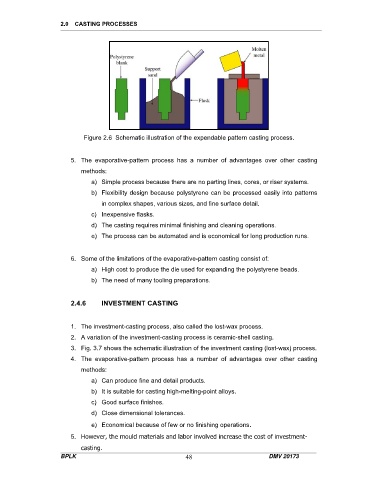
                             Figure 2.6  Schematic illustration of the expendable pattern casting process.

                        5.  The  evaporative-pattern  process  has  a  number  of  advantages  over  other  casting
                            methods:

                               a)  Simple process because there are no parting lines, cores, or riser systems.
                               b)  Flexibility design because polystyrene can be processed easily into patterns
                                   in complex shapes, various sizes, and fine surface detail.

                               c)  Inexpensive flasks.
                               d)  The casting requires minimal finishing and cleaning operations.
                               e)  The process can be automated and is economical for long production runs.


                        6.  Some of the limitations of the evaporative-pattern casting consist of:
                               a)  High cost to produce the die used for expanding the polystyrene beads.
                               b)  The need of many tooling preparations.


                        2.4.6      INVESTMENT CASTING


                        1.  The investment-casting process, also called the lost-wax process.
                        2.  A variation of the investment-casting process is ceramic-shell casting.
                        3.  Fig. 3.7 shows the schematic illustration of the investment casting (lost-wax) process.
                        4.  The  evaporative-pattern  process  has  a  number  of  advantages  over  other  casting

                            methods:
                               a)  Can produce fine and detail products.
                               b)  It is suitable for casting high-melting-point alloys.
                               c)  Good surface finishes.
                               d)  Close dimensional tolerances.

                               e)  Economical because of few or no finishing operations.
                        5.  However, the mould materials and labor involved increase the cost of investment-

                            casting.
                     BPLK                                       48                         DMV 20173

