


Page 21 - Module DMV20173
P. 21
2.0    CASTING PROCESSES


                     2.5.4  DIE CASTING


                        1.  The die casting process is a further example of permanent-mould casting.

                        2.  Typical  parts  made  by  die  casting  are  motor  housings,  engine  blocks,  business-
                            machine and appliance components, hand tools, and toys.
                        3.  In this process, the molten metal is forced into the die cavity at high pressures.
                        4.  Die casting has the capability for rapid production of strong, high-quality parts with
                            complex shapes, especially with aluminum, brass, magnesium, and zinc.

                        5.  These machines are large compared to the size of the casting, because high forces
                            are required to keep the two halves of the dies closed under pressure.
                        6.  It also produces good dimensional accuracy and surface details, so that parts require

                            little or no subsequent machining or finishing operations (net-shape forming).
                        7.  There are two basic types of die-casting machines:
                               a)  Hot-chamber die-casting.
                               b)  Cold-chamber die-casting.


                     2.5.5  HOT-CHAMBER DIE-CASTING


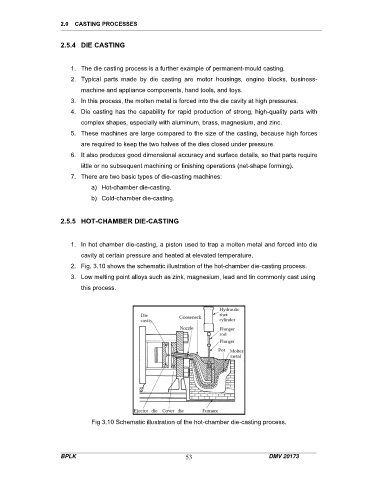
                        1.  In hot chamber die-casting, a piston used to trap a molten metal and forced into die
                            cavity at certain pressure and heated at elevated temperature.
                        2.  Fig. 3.10 shows the schematic illustration of the hot-chamber die-casting process.
                        3.  Low melting point alloys such as zink, magnesium, lead and tin commonly cast using

                            this process.


                               Fig 3.10 Schematic illustration of the hot-chamber die-casting process.


                     BPLK                                       53                         DMV 20173

