


Page 19 - Module DMV20173
P. 19
2.0    CASTING PROCESSES


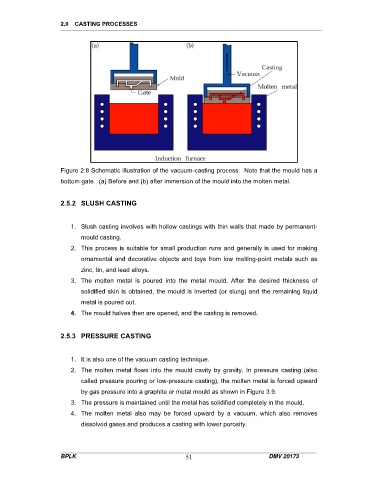
                     Figure 2.8 Schematic illustration of the vacuum-casting process.  Note that the mould has a

                     bottom gate.  (a) Before and (b) after immersion of the mould into the molten metal.

                     2.5.2  SLUSH CASTING


                        1.  Slush casting involves with hollow castings with thin walls that made by permanent-
                            mould casting.
                        2.  This process is suitable for small production runs and generally is used for making

                            ornamental and decorative objects and toys from low melting-point metals such as
                            zinc, tin, and lead alloys.
                        3.  The  molten  metal  is  poured  into  the  metal  mould.  After  the  desired  thickness  of
                            solidified skin is obtained, the mould is inverted (or slung) and the remaining liquid

                            metal is poured out.
                        4.  The mould halves then are opened, and the casting is removed.

                     2.5.3   PRESSURE CASTING


                        1.  It is also one of the vacuum casting technique.

                        2.  The  molten  metal  flows  into  the  mould  cavity  by  gravity.  In  pressure  casting  (also
                            called pressure pouring or low-pressure casting), the molten metal is forced upward
                            by gas pressure into a graphite or metal mould as shown in Figure 3.9.
                        3.  The pressure is maintained until the metal has solidified completely in the mould.
                        4.  The  molten  metal  also  may  be  forced  upward  by  a  vacuum,  which  also  removes

                            dissolved gases and produces a casting with lower porosity.


                     BPLK                                       51                         DMV 20173

