


Page 47 - Module DMV20173
P. 47
3.0 SHEET METAL PROCESSES


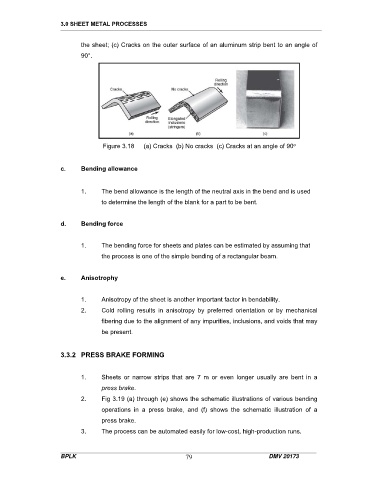
                            the sheet; (c) Cracks on the outer surface of an aluminum strip bent to an angle of

                            90°.


                                   Figure 3.18   (a) Cracks  (b) No cracks  (c) Cracks at an angle of 90
                                                                                                  o

                     c.     Bending allowance


                            1.     The bend allowance is the length of the neutral axis in the bend and is used
                                   to determine the length of the blank for a part to be bent.

                     d.     Bending force


                            1.     The bending force for sheets and plates can be estimated by assuming that
                                   the process is one of the simple bending of a rectangular beam.


                     e.     Anisotrophy

                            1.     Anisotropy of the sheet is another important factor in bendability.
                            2.     Cold  rolling  results  in  anisotropy  by  preferred  orientation  or  by  mechanical

                                   fibering due to the alignment of any impurities, inclusions, and voids that may
                                   be present.

                     3.3.2  PRESS BRAKE FORMING


                            1.     Sheets  or  narrow  strips  that  are  7  m  or  even  longer  usually  are  bent  in  a
                                   press brake.

                            2.     Fig 3.19 (a) through (e) shows the schematic illustrations of various bending
                                   operations  in  a  press  brake,  and  (f)  shows  the  schematic  illustration  of  a
                                   press brake.
                            3.     The process can be automated easily for low-cost, high-production runs.


                     BPLK                                       79                         DMV 20173

