


Page 59 - Module DMV20173
P. 59
3.0 SHEET METAL PROCESSES


                        8.  When selected properly, rubber-forming and hydroforming processes have the
                            advantages of :
                                (a) the capability to form complex shapes;

                                (b) forming parts with laminated sheets of various materials and coatings;
                                (c) flexibility and ease of operation;
                                (d) the avoidance of damage to the surfaces of the sheet;
                                (e) low die wear;
                                (f) low tooling cost.


                     3.4.2   SPINNING


                     Spinning is a process which involves the forming of axisymmetric parts over a mandrel by
                     the use of various tools and rollers—a process that is similar to that of forming clay on a
                     potter’s wheel.

                     a.     Conventional spinning

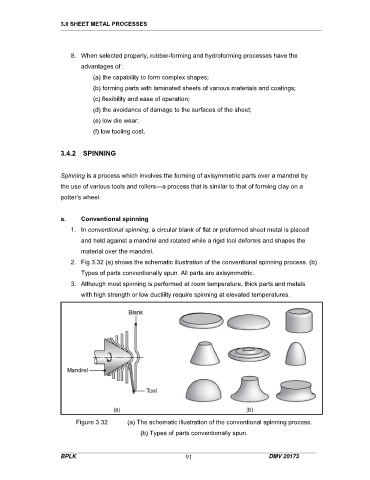
                        1.  In conventional spinning, a circular blank of flat or preformed sheet metal is placed
                            and held against a mandrel and rotated while a rigid tool deforms and shapes the
                            material over the mandrel.
                        2.  Fig 3.32 (a) shows the schematic illustration of the conventional spinning process. (b)

                            Types of parts conventionally spun. All parts are axisymmetric.
                        3.  Although most spinning is performed at room temperature, thick parts and metals
                            with high strength or low ductility require spinning at elevated temperatures.


                          Figure 3.32      (a) The schematic illustration of the conventional spinning process.

                                               (b) Types of parts conventionally spun.


                     BPLK                                       91                         DMV 20173

