


Page 60 - Module DMV20173
P. 60
3.0 SHEET METAL PROCESSES


                        b.  Shear spinning

                        1.  Also  known  as  power spinning,  flow turning,  hydrospinning,  and  spin forging,  this

                            operation  produces  an  axisymmetric  conical  or  curvilinear  shape,  reducing  the
                            sheet’s thickness while maintaining its maximum (blank) diameter.
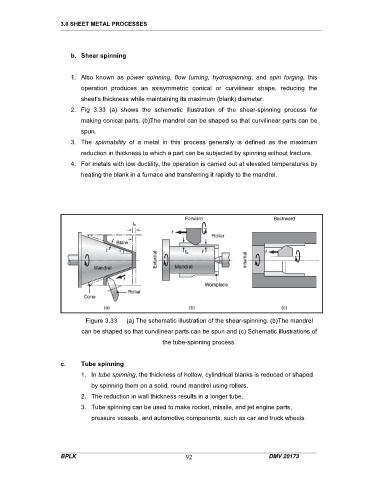
                        2.  Fig  3.33  (a)  shows  the  schematic  illustration  of  the  shear-spinning  process  for
                            making conical parts. (b)The mandrel can be shaped so that curvilinear parts can be
                            spun.

                        3.  The  spinnability  of  a  metal  in  this  process  generally  is  defined  as  the  maximum
                            reduction in thickness to which a part can be subjected by spinning without fracture.
                        4.  For metals with low ductility, the operation is carried out at elevated temperatures by
                            heating the blank in a furnace and transferring it rapidly to the mandrel.


                             Figure 3.33   (a) The schematic illustration of the shear-spinning. (b)The mandrel

                            can be shaped so that curvilinear parts can be spun and (c) Schematic illustrations of
                                                       the tube-spinning process.

                     c.     Tube spinning
                            1.  In tube spinning, the thickness of hollow, cylindrical blanks is reduced or shaped

                               by spinning them on a solid, round mandrel using rollers.
                            2.  The reduction in wall thickness results in a longer tube.
                            3.  Tube spinning can be used to make rocket, missile, and jet engine parts,

                               pressure vessels, and automotive components, such as car and truck wheels.


                     BPLK                                       92                         DMV 20173

