


Page 505 - Python Data Science Handbook
P. 505
How many components?

               The fact that GMM is a generative model gives us a natural means of determining the
               optimal number of components for a given dataset. A generative model is inherently
               a probability distribution for the dataset, and so we can simply evaluate the likelihood
               of the data under the model, using cross-validation to avoid overfitting. Another
               means of correcting for overfitting is to adjust the model likelihoods using some ana‐
               lytic criterion such as the Akaike information criterion (AIC) or the Bayesian infor‐
               mation criterion (BIC). Scikit-Learn’s GMM estimator actually includes built-in
               methods that compute both of these, and so it is very easy to operate on this
               approach.

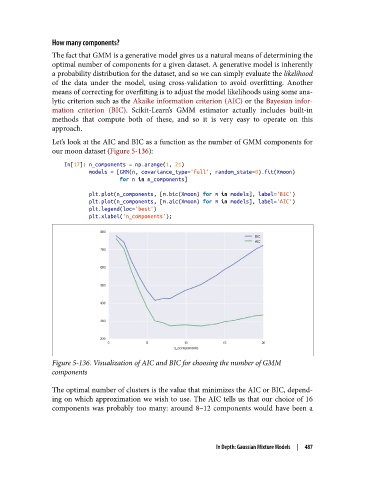
               Let’s look at the AIC and BIC as a function as the number of GMM components for
               our moon dataset (Figure 5-136):

                   In[17]: n_components = np.arange(1, 21)
                           models = [GMM(n, covariance_type='full', random_state=0).fit(Xmoon)
                                     for n in n_components]

                           plt.plot(n_components, [m.bic(Xmoon) for m in models], label='BIC')
                           plt.plot(n_components, [m.aic(Xmoon) for m in models], label='AIC')
                           plt.legend(loc='best')
                           plt.xlabel('n_components');


               Figure 5-136. Visualization of AIC and BIC for choosing the number of GMM
               components

               The optimal number of clusters is the value that minimizes the AIC or BIC, depend‐
               ing on which approximation we wish to use. The AIC tells us that our choice of 16
               components was probably too many: around 8–12 components would have been a


                                                             In Depth: Gaussian Mixture Models  |  487

