


Page 500 - Python Data Science Handbook
P. 500
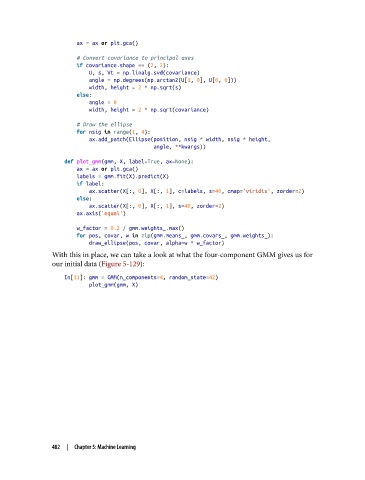
ax = ax or plt.gca()
                       # Convert covariance to principal axes
                       if covariance.shape == (2, 2):
                           U, s, Vt = np.linalg.svd(covariance)
                           angle = np.degrees(np.arctan2(U[1, 0], U[0, 0]))
                           width, height = 2 * np.sqrt(s)
                       else:
                           angle = 0
                           width, height = 2 * np.sqrt(covariance)

                       # Draw the ellipse
                       for nsig in range(1, 4):
                           ax.add_patch(Ellipse(position, nsig * width, nsig * height,
                                                angle, **kwargs))
                   def plot_gmm(gmm, X, label=True, ax=None):
                       ax = ax or plt.gca()
                       labels = gmm.fit(X).predict(X)
                       if label:
                           ax.scatter(X[:, 0], X[:, 1], c=labels, s=40, cmap='viridis', zorder=2)
                       else:
                           ax.scatter(X[:, 0], X[:, 1], s=40, zorder=2)
                       ax.axis('equal')

                       w_factor = 0.2 / gmm.weights_.max()
                       for pos, covar, w in zip(gmm.means_, gmm.covars_, gmm.weights_):
                           draw_ellipse(pos, covar, alpha=w * w_factor)
               With this in place, we can take a look at what the four-component GMM gives us for
               our initial data (Figure 5-129):

                   In[11]: gmm = GMM(n_components=4, random_state=42)
                           plot_gmm(gmm, X)


               482  |  Chapter 5: Machine Learning

