


Page 507 - Python Data Science Handbook
P. 507
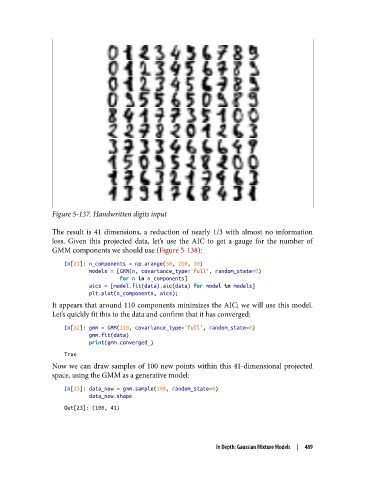
Figure 5-137. Handwritten digits input

               The result is 41 dimensions, a reduction of nearly 1/3 with almost no information
               loss. Given this projected data, let’s use the AIC to get a gauge for the number of
               GMM components we should use (Figure 5-138):

                   In[21]: n_components = np.arange(50, 210, 10)
                           models = [GMM(n, covariance_type='full', random_state=0)
                                     for n in n_components]
                           aics = [model.fit(data).aic(data) for model in models]
                           plt.plot(n_components, aics);
               It appears that around 110 components minimizes the AIC; we will use this model.
               Let’s quickly fit this to the data and confirm that it has converged:

                   In[22]: gmm = GMM(110, covariance_type='full', random_state=0)
                           gmm.fit(data)
                           print(gmm.converged_)
                   True
               Now we can draw samples of 100 new points within this 41-dimensional projected
               space, using the GMM as a generative model:
                   In[23]: data_new = gmm.sample(100, random_state=0)
                           data_new.shape
                   Out[23]: (100, 41)


                                                             In Depth: Gaussian Mixture Models  |  489

