


Page 54 - Python Data Science Handbook
P. 54
struct _longobject {
                       long ob_refcnt;
                       PyTypeObject *ob_type;
                       size_t ob_size;
                       long ob_digit[1];
                   };
               A single integer in Python 3.4 actually contains four pieces:

                 • ob_refcnt, a reference count that helps Python silently handle memory alloca‐
                   tion and deallocation

                 • ob_type, which encodes the type of the variable
                 • ob_size, which specifies the size of the following data members
                 • ob_digit, which contains the actual integer value that we expect the Python vari‐
                   able to represent

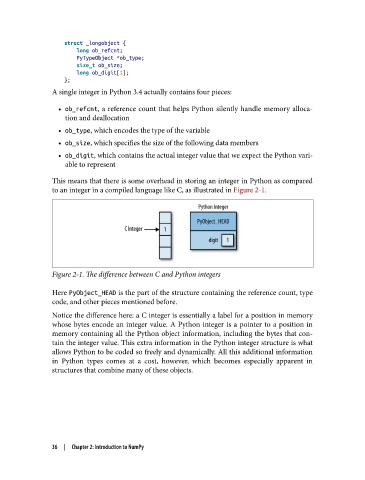
               This means that there is some overhead in storing an integer in Python as compared
               to an integer in a compiled language like C, as illustrated in Figure 2-1.


               Figure 2-1. The difference between C and Python integers


               Here PyObject_HEAD is the part of the structure containing the reference count, type
               code, and other pieces mentioned before.
               Notice the difference here: a C integer is essentially a label for a position in memory
               whose bytes encode an integer value. A Python integer is a pointer to a position in
               memory containing all the Python object information, including the bytes that con‐
               tain the integer value. This extra information in the Python integer structure is what
               allows Python to be coded so freely and dynamically. All this additional information
               in Python types comes at a cost, however, which becomes especially apparent in
               structures that combine many of these objects.


               36  |  Chapter 2: Introduction to NumPy

