


Page 56 - Python Data Science Handbook
P. 56
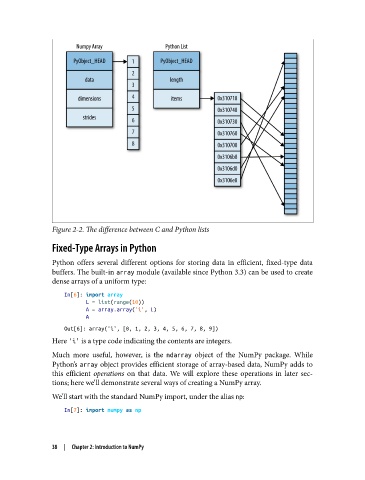
Figure 2-2. The difference between C and Python lists

               Fixed-Type Arrays in Python
               Python offers several different options for storing data in efficient, fixed-type data
               buffers. The built-in array module (available since Python 3.3) can be used to create
               dense arrays of a uniform type:
                   In[6]: import array
                          L = list(range(10))
                          A = array.array('i', L)
                          A
                   Out[6]: array('i', [0, 1, 2, 3, 4, 5, 6, 7, 8, 9])
               Here 'i' is a type code indicating the contents are integers.
               Much more useful, however, is the ndarray  object of the NumPy package. While
               Python’s array object provides efficient storage of array-based data, NumPy adds to
               this efficient operations  on that data. We will explore these operations in later sec‐
               tions; here we’ll demonstrate several ways of creating a NumPy array.
               We’ll start with the standard NumPy import, under the alias np:

                   In[7]: import numpy as np


               38  |  Chapter 2: Introduction to NumPy

