


Page 55 - Python Data Science Handbook
P. 55
A Python List Is More Than Just a List

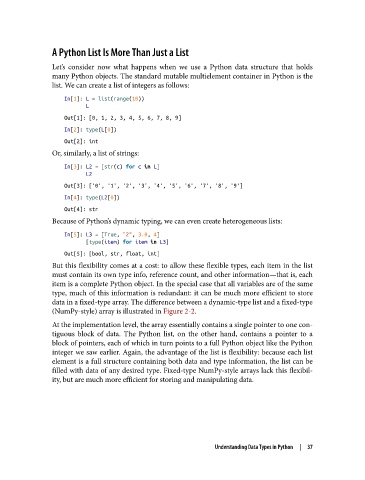
               Let’s consider now what happens when we use a Python data structure that holds
               many Python objects. The standard mutable multielement container in Python is the
               list. We can create a list of integers as follows:
                   In[1]: L = list(range(10))
                          L
                   Out[1]: [0, 1, 2, 3, 4, 5, 6, 7, 8, 9]
                   In[2]: type(L[0])
                   Out[2]: int
               Or, similarly, a list of strings:
                   In[3]: L2 = [str(c) for c in L]
                          L2
                   Out[3]: ['0', '1', '2', '3', '4', '5', '6', '7', '8', '9']

                   In[4]: type(L2[0])
                   Out[4]: str
               Because of Python’s dynamic typing, we can even create heterogeneous lists:

                   In[5]: L3 = [True, "2", 3.0, 4]
                          [type(item) for item in L3]
                   Out[5]: [bool, str, float, int]
               But this flexibility comes at a cost: to allow these flexible types, each item in the list
               must contain its own type info, reference count, and other information—that is, each
               item is a complete Python object. In the special case that all variables are of the same
               type, much of this information is redundant: it can be much more efficient to store
               data in a fixed-type array. The difference between a dynamic-type list and a fixed-type
               (NumPy-style) array is illustrated in Figure 2-2.
               At the implementation level, the array essentially contains a single pointer to one con‐
               tiguous block of data. The Python list, on the other hand, contains a pointer to a
               block of pointers, each of which in turn points to a full Python object like the Python
               integer we saw earlier. Again, the advantage of the list is flexibility: because each list
               element is a full structure containing both data and type information, the list can be
               filled with data of any desired type. Fixed-type NumPy-style arrays lack this flexibil‐
               ity, but are much more efficient for storing and manipulating data.


                                                            Understanding Data Types in Python  |  37

