


Page 59 - Python Data Science Handbook
P. 59
NumPy Standard Data Types
NumPy arrays contain values of a single type, so it is important to have detailed
knowledge of those types and their limitations. Because NumPy is built in C, the
types will be familiar to users of C, Fortran, and other related languages.
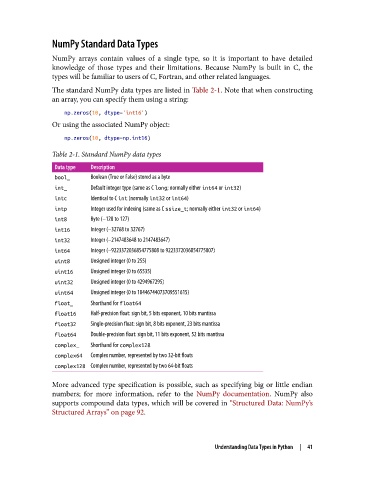
The standard NumPy data types are listed in Table 2-1. Note that when constructing
an array, you can specify them using a string:
np.zeros(10, dtype='int16')
Or using the associated NumPy object:
np.zeros(10, dtype=np.int16)
Table 2-1. Standard NumPy data types
Data type Description
bool_ Boolean (True or False) stored as a byte
int_ Default integer type (same as C long; normally either int64 or int32)
intc Identical to C int (normally int32 or int64)
intp Integer used for indexing (same as C ssize_t; normally either int32 or int64)
int8 Byte (–128 to 127)
int16 Integer (–32768 to 32767)
int32 Integer (–2147483648 to 2147483647)
int64 Integer (–9223372036854775808 to 9223372036854775807)
uint8 Unsigned integer (0 to 255)
uint16 Unsigned integer (0 to 65535)
uint32 Unsigned integer (0 to 4294967295)
uint64 Unsigned integer (0 to 18446744073709551615)
float_ Shorthand for float64
float16 Half-precision oat: sign bit, 5 bits exponent, 10 bits mantissa
float32 Single-precision oat: sign bit, 8 bits exponent, 23 bits mantissa
float64 Double-precision oat: sign bit, 11 bits exponent, 52 bits mantissa
complex_ Shorthand for complex128
complex64 Complex number, represented by two 32-bit oats
complex128 Complex number, represented by two 64-bit oats
More advanced type specification is possible, such as specifying big or little endian
numbers; for more information, refer to the NumPy documentation. NumPy also
supports compound data types, which will be covered in “Structured Data: NumPy’s
Structured Arrays” on page 92.
Understanding Data Types in Python | 41

