


Page 105 - Template Tesis UTM v2.0
P. 105
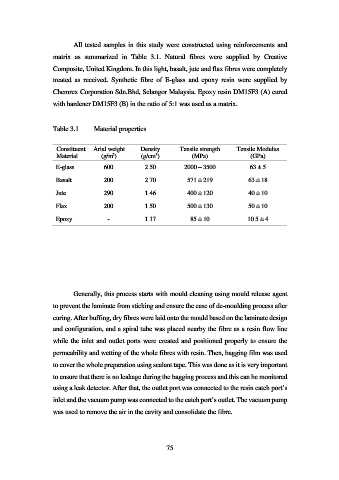
All tested samples in this study were constructed using reinforcements  and

                   matrix  as  summarized  in  Table  3.1.  Natural  fibres  were  supplied  by  Creative
                   Composite, United Kingdom. In this light, basalt, jute and flax fibres were completely

                   treated  as  received.  Synthetic  fibre  of  E-glass  and  epoxy  resin  were  supplied  by
                   Chemrex Corporation Sdn.Bhd, Selangor Malaysia. Epoxy resin DM15F3 (A) cured

                   with hardener DM15F3 (B) in the ratio of 5:1 was used as a matrix.


                   Table 3.1      Material properties


                     Constituent   Arial weight   Density       Tensile strength    Tensile Modulus
                     Material       (g/m )        (g/cm )           (MPa)                (GPa)
                                        2
                                                       3
                     E-glass         600            2.50          2000 – 3500            63 ± 5

                     Basalt          200            2.70           571 ± 219            63 ± 18

                     Jute            290            1.46           400 ± 120            40 ± 10
                     Flax            200            1.50           500 ± 130            50 ± 10

                     Epoxy             -            1.17            85 ± 10             10.5 ± 4


                   3.2     Fabrication of the Composite Laminates using VIP Process


                           Generally, this process starts with mould cleaning using mould release agent
                   to prevent the laminate from sticking and ensure the ease of de-moulding process after

                   curing. After buffing, dry fibres were laid onto the mould based on the laminate design
                   and configuration, and a spiral tube was placed nearby the fibre as a resin flow line

                   while the inlet and outlet ports were created and positioned properly to ensure the

                   permeability and wetting of the whole fibres with resin. Then, bagging film was used
                   to cover the whole preparation using sealant tape. This was done as it is very important

                   to ensure that there is no leakage during the bagging process and this can be monitored
                   using a leak detector. After that, the outlet port was connected to the resin catch port’s

                   inlet and the vacuum pump was connected to the catch port’s outlet. The vacuum pump

                   was used to remove the air in the cavity and consolidate the fibre.


                                                           75

