


Page 136 - Template Tesis UTM v2.0
P. 136
140          Specific Tensile Strength  Specific Tensile Modulus     12


                         120                                                                  10
                        Specific Tensile Strength (MPa.dm 3 /kg)  80                          8    Specific Tensile Modulus (GPa.dm 3 /kg)

                         100


                                                                                              6
                          60

                                                                                              4
                          40


                          20                                                                  2


                           0                                                                  0
                                   [G/B]3G                             [G/J]3G                              [G/F]3G
                                                            S5
                                       S4
                                                                                 S6


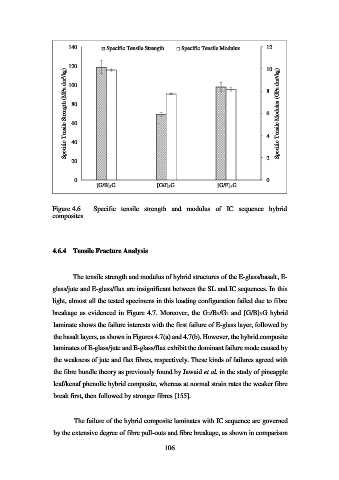
                   Figure 4.6     Specific  tensile  strength  and  modulus  of  IC  sequence  hybrid
                   composites


                   4.6.4  Tensile Fracture Analysis


                           The tensile strength and modulus of hybrid structures of the E-glass/basalt, E-


                   glass/jute and E-glass/flax are insignificant between the SL and IC sequences. In this
                   light, almost all the tested specimens in this loading configuration failed due to fibre

                   breakage as evidenced in Figure 4.7. Moreover, the G2/B3/G2 and [G/B]3G hybrid
                   laminate shows the failure interests with the first failure of E-glass layer, followed by

                   the basalt layers, as shown in Figures 4.7(a) and 4.7(b). However, the hybrid composite
                   laminates of E-glass/jute and E-glass/flax exhibit the dominant failure mode caused by

                   the weakness of jute and flax fibres, respectively. These kinds of failures agreed with

                   the fibre bundle theory as previously found by Jawaid et al. in the study of pineapple
                   leaf/kenaf phenolic hybrid composite, whereas at normal strain rates the weaker fibre

                   break first, then followed by stronger fibres [155].


                           The failure of the hybrid composite laminates with IC sequence are governed

                   by the extensive degree of fibre pull-outs and fibre breakage, as shown in comparison

                                                           106

