


Page 154 - Template Tesis UTM v2.0
P. 154
2.0


                         1.6

                        Peak force (kN)  1.2


                         0.8


                         0.4


                         0.0
                                G2/B3/G2              G2/J3/G2                G2/F3/G2               [G/B]3G          [G/J]3G           [G/F]3G


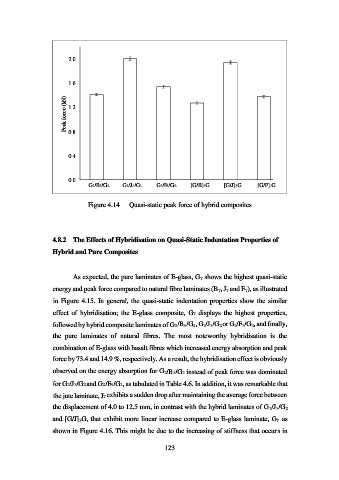
                                Figure 4.14   Quasi-static peak force of hybrid composites


                   4.8.2  The Effects of Hybridisation on Quasi-Static Indentation Properties of

                   Hybrid and Pure Composites


                           As expected, the pure laminates of E-glass, G7 shows the highest quasi-static


                   energy and peak force compared to natural fibre laminates (B7, J7 and F7), as illustrated
                   in  Figure  4.15.  In  general,  the quasi-static indentation  properties show the similar

                   effect  of  hybridisation;  the  E-glass  composite,  G7  displays  the  highest  properties,
                   followed by hybrid composite laminates of G2/B3/G2, G2/J3/G2 or G2/F3/G2, and finally,

                   the  pure  laminates  of  natural  fibres.  The  most  noteworthy  hybridisation  is  the
                   combination of E-glass with basalt fibres which increased energy absorption and peak

                   force by 73.4 and 14.9 %, respectively. As a result, the hybridisation effect is obviously

                   observed on the energy absorption for G2/B3/G2 instead of peak force was dominated
                   for G2/J3/G2 and G2/F3/G2, as tabulated in Table 4.6. In addition, it was remarkable that

                   the jute laminate, J7 exhibits a sudden drop after maintaining the average force between

                   the displacement of 4.0 to 12.5 mm, in contrast with the hybrid laminates of G2/J3/G2
                   and [G/J]3G, that exhibit more linear increase compared to E-glass laminate, G7 as

                   shown in Figure 4.16. This might be due to the increasing of stiffness that occurs in

                                                           123

