


Page 179 - Template Tesis UTM v2.0
P. 179
4.10.2  The Effect of Stacking Sequence on the Stress-Strain Curves at Different

                   Strain Rates of E-glass/Basalt, E-glass/Jute and E-glass/Flax


                           A compressive stress-strain diagram is generally present several mechanical

                   properties  of  the  material,  including  compressive  strength,  compressive  modulus,
                   strain rate sensitivity and failure modes. Figures 4.32 to 4.37 exhibit the stress-strain

                   curves  of  E-glass/basalt,  E-glass/jute  and  E-glass/flax  on  the  effect  of  stacking

                   sequence between SL and IC sequences at the different strain rates in the range of 750
                            -1
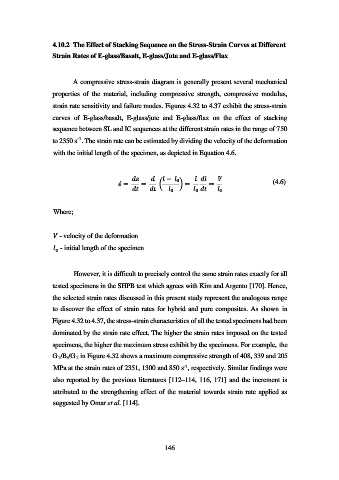
                   to 2350 s . The strain rate can be estimated by dividing the velocity of the deformation
                   with the initial length of the specimen, as depicted in Equation 4.6.


                                                             −    0
                                            ̇ =   =      (      ) =       =                      (4.6)
                                                               0                 0
                                                                     0


                   Where;


                      - velocity of the deformation

                       - initial length of the specimen
                    0


                           However, it is difficult to precisely control the same strain rates exactly for all

                   tested specimens in the SHPB test which agrees with Kim and Argento [170]. Hence,
                   the selected strain rates discussed in this present study represent the analogous range

                   to discover the effect of strain rates for hybrid and pure composites. As shown in

                   Figure 4.32 to 4.37, the stress-strain characteristics of all the tested specimens had been
                   dominated by the strain rate effect. The higher the strain rates imposed on the tested

                   specimens, the higher the maximum stress exhibit by the specimens. For example, the
                   G2/B3/G2 in Figure 4.32 shows a maximum compressive strength of 408, 339 and 205

                                                                 -1
                   MPa at the strain rates of 2351, 1300 and 850 s , respectively. Similar findings were
                   also reported by the previous literatures  [112–114, 116, 171] and the increment is

                   attributed to the strengthening effect of the material towards strain rate applied as

                   suggested by Omar et al. [114].


                                                           146

