


Page 184 - Template Tesis UTM v2.0
P. 184
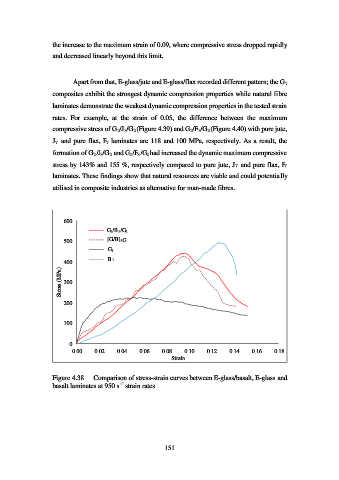
the increase to the maximum strain of 0.09, where compressive stress dropped rapidly

                   and decreased linearly beyond this limit.


                           Apart from that, E-glass/jute and E-glass/flax recorded different pattern; the G7

                   composites exhibit the strongest dynamic compression properties while natural fibre
                   laminates demonstrate the weakest dynamic compression properties in the tested strain

                   rates.  For  example,  at  the  strain  of  0.05,  the  difference  between  the  maximum

                   compressive stress of G2/J3/G2 (Figure 4.39) and G2/F3/G2 (Figure 4.40) with pure jute,
                   J7 and pure flax, F7 laminates are 118 and 100 MPa, respectively. As a result, the

                   formation of G2/J3/G2 and G2/F3/G2 had increased the dynamic maximum compressive
                   stress by 143% and 155 %, respectively compared to pure jute, J7 and pure flax, F7

                   laminates. These findings show that natural resources are viable and could potentially
                   utilised in composite industries as alternative for man-made fibres.


                       600
                                      S1 2/B3/G2
                                       G
                                      S4
                       500             [G/B]3G

                                      S77
                                          G

                                      S87
                                        B
                       400

                      Stress (MPa)  300


                       200


                       100


                         0
                          0.00    0.02    0.04    0.06    0.08   0.10    0.12    0.14    0.16    0.18
                                                             Strain


                   Figure 4.38    Comparison of stress-strain curves between E-glass/basalt, E-glass and
                                           -1
                   basalt laminates at 950 s  strain rates


                                                           151

