


Page 183 - Template Tesis UTM v2.0
P. 183
700/s        1125/s       2310/s
                         300


                         250


                         200
                        Stress (MPa)  150


                         100


                          50


                           0
                             0            0.02         0.04          0.06          0.08          0.1
                                                             Strain


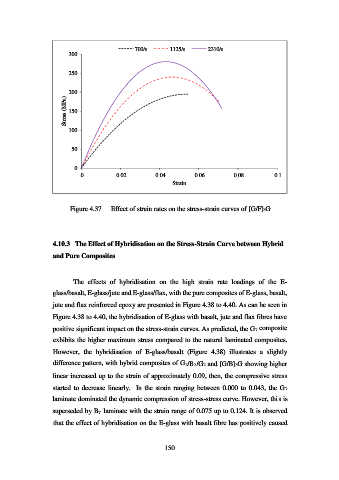
                         Figure 4.37    Effect of strain rates on the stress-strain curves of [G/F]3G


                   4.10.3   The Effect of Hybridisation on the Stress-Strain Curve between Hybrid
                   and Pure Composites


                           The  effects  of  hybridisation  on  the  high  strain  rate  loadings  of  the  E-
                   glass/basalt, E-glass/jute and E-glass/flax, with the pure composites of E-glass, basalt,

                   jute and flax reinforced epoxy are presented in Figure 4.38 to 4.40. As can be seen in
                   Figure 4.38 to 4.40, the hybridisation of E-glass with basalt, jute and flax fibres have

                   positive significant impact on the stress-strain curves. As predicted, the G7 composite

                   exhibits the higher maximum stress compared to the natural laminated composites.
                   However,  the  hybridisation  of  E-glass/basalt  (Figure  4.38)  illustrates  a  slightly

                   difference pattern, with hybrid composites of G2/B3/G2 and [G/B]3G showing higher

                   linear increased up to the strain of approximately 0.09, then, the compressive stress
                   started to  decrease linearly.   In the strain  ranging between 0.000 to  0.043, the G7

                   laminate dominated the dynamic compression of stress-stress curve. However, this is
                   superseded by B7 laminate with the strain range of 0.075 up to 0.124. It is observed

                   that the effect of hybridisation on the E-glass with basalt fibre has positively caused


                                                           150

