


Page 47 - Template Tesis UTM v2.0
P. 47
2.5.3  Aramid Fibre


                           Aramid fibres were commercially introduced in the early 1970s by E.I. Du Pont

                   de Nemours & Company, Inc., under the trade name of Kevlar. Aramid fibres exhibit

                   distinctive characteristics such as light weight and have high strength and toughness.
                   This  has  led  to  the  fibres’  applications  in  composites  for  pressure  vessels,  ship

                   building,  heat  resistance  attire,  fire  blankets,  reinforcement  for  high-speed  tyre,

                   bulletproof vests,  vehicle protection,  and as fabric for  aircraft  and containers. The
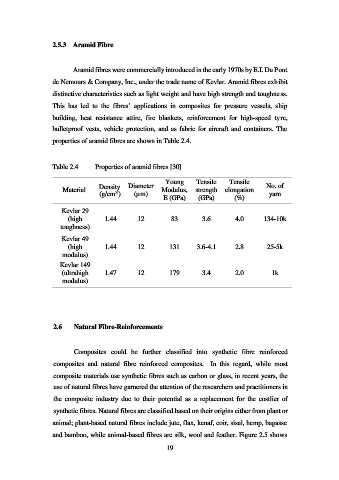
                   properties of aramid fibres are shown in Table 2.4.


                   Table 2.4       Properties of aramid fibres [30]

                                                           Young      Tensile    Tensile
                                    Density  Diameter                                         No. of
                       Material                          Modulus,  strength  elongation
                                         3
                                    (g/cm )     (µm)                                           yarn
                                                          E (GPa)     (GPa)        (%)
                      Kevlar 29
                         (high       1.44        12          83         3.6        4.0       134-10k
                      toughness)

                      Kevlar 49
                         (high       1.44        12         131       3.6-4.1      2.8        25-5k
                       modulus)
                      Kevlar 149
                      (ultrahigh     1.47        12         179         3.4        2.0          1k
                       modulus)


                   2.6     Natural Fibre-Reinforcements


                           Composites  could  be  further  classified  into  synthetic  fibre  reinforced

                   composites  and  natural  fibre  reinforced  composites.    In  this  regard,  while  most

                   composite materials use synthetic fibres such as carbon or glass, in recent years, the
                   use of natural fibres have garnered the attention of the researchers and practitioners in

                   the  composite  industry  due  to  their  potential  as  a  replacement  for  the  costlier  of
                   synthetic fibres. Natural fibres are classified based on their origins either from plant or

                   animal; plant-based natural fibres include jute, flax, kenaf, coir, sisal, hemp, bagasse
                   and bamboo, while animal-based fibres are silk, wool and feather. Figure 2.5 shows

                                                           19

