


Page 52 - Template Tesis UTM v2.0
P. 52
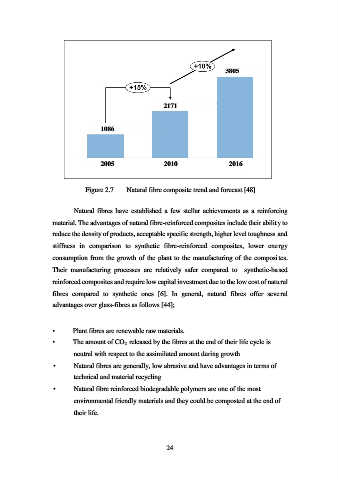
3805


                                                           2171


                                      1086


                                      2005                             2010                              2016


                               Figure 2.7    Natural fibre composite trend and forecast [48]


                           Natural  fibres  have  established  a  few  stellar  achievements  as  a  reinforcing

                   material. The advantages of natural fibre-reinforced composites include their ability to
                   reduce the density of products, acceptable specific strength, higher level toughness and

                   stiffness  in  comparison  to  synthetic  fibre-reinforced  composites,  lower  energy

                   consumption from the growth of the plant to the manufacturing of the composites.
                   Their  manufacturing  processes  are  relatively  safer  compared  to    synthetic-based

                   reinforced composites and require low capital investment due to the low cost of natural

                   fibres  compared  to  synthetic  ones  [6].  In  general,  natural  fibres  offer  several
                   advantages over glass-fibres as follows [44];


                   •       Plant fibres are renewable raw materials.
                   •       The amount of CO2 released by the fibres at the end of their life cycle is

                           neutral with respect to the assimilated amount during growth
                   •       Natural fibres are generally, low abrasive and have advantages in terms of

                           technical and material recycling

                   •       Natural fibre reinforced biodegradable polymers are one of the most
                           environmental friendly materials and they could be composted at the end of

                           their life.


                                                           24

