


Page 87 - Template Tesis UTM v2.0
P. 87
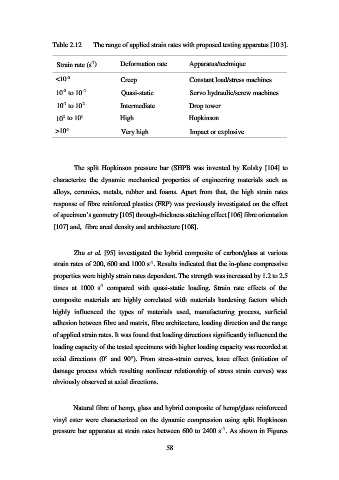
Table 2.12     The range of applied strain rates with proposed testing apparatus [103].


                                 -1
                     Strain rate (s )      Deformation rate        Apparatus/technique
                        -5
                     <10                   Creep                   Constant load/stress machines
                              -1
                       -5
                     10  to 10             Quasi-static            Servo hydraulic/screw machines
                       -1
                              2
                     10  to 10             Intermediate            Drop tower
                             4
                       2
                     10  to 10             High                    Hopkinson
                        4
                     >10                   Very high               Impact or explosive


                           The split Hopkinson pressure bar (SHPB was invented by Kolsky  [104] to
                   characterize  the  dynamic  mechanical  properties  of  engineering  materials  such  as

                   alloys,  ceramics,  metals,  rubber  and  foams.  Apart  from  that,  the  high  strain  rates

                   response of fibre reinforced plastics (FRP) was previously investigated on the effect
                   of specimen’s geometry [105] through-thickness stitching effect [106] fibre orientation

                   [107] and,  fibre areal density and architecture [108].


                           Zhu et al. [95] investigated the hybrid composite of carbon/glass at various

                                                     -1
                   strain rates of 200, 600 and 1000 s . Results indicated that the in-plane compressive
                   properties were highly strain rates dependent. The strength was increased by 1.2 to 2.5
                                    -1
                   times  at  1000  s   compared  with  quasi-static  loading.  Strain  rate  effects  of  the
                   composite  materials  are  highly  correlated  with  materials  hardening  factors  which
                   highly  influenced  the  types  of  materials  used,  manufacturing  process,  surficial

                   adhesion between fibre and matrix, fibre architecture, loading direction and the range
                   of applied strain rates. It was found that loading directions significantly influenced the

                   loading capacity of the tested specimens with higher loading capacity was recorded at

                   axial  directions  (0°  and  90°).  From  stress-strain  curves,  knee  effect  (initiation  of
                   damage process  which resulting nonlinear relationship of stress strain  curves) was

                   obviously observed at axial directions.


                           Natural fibre of hemp, glass and hybrid composite of hemp/glass reinforcced

                   vinyl  ester were characterized on the dynamic  compression using split  Hopkinosn

                                                                              -1
                   pressure bar apparatus at strain rates between 600 to 2400 s . As shown in Figures
                                                           58

