


Page 92 - Template Tesis UTM v2.0
P. 92
and  modulus  are  highly  dependent  on  the  strain  rate  whereby  higher  dynamic

                   compression properties were recorded by the tested specimens when the higher strain
                   rates were applied [116].


                           The  application  of  composite  materials  in  composite  armor  and  naval
                   structures required the characterisation of through thickness properties. Govender et

                   al.  [117] has conducted the quasi-static and SHPB tests on glass/vinyl ester specimens
                                                                -1
                                                   -1
                   at 1.0 mm/min (   = 2.5 x 10⁻³ s ) and 5100 s , respectively. Result showed that the
                   higher the strain rate, the higher compressive strength is shown by the specimens. The

                   quasi-static exhibited the compressive stress of 417 MPa, which is 9.74 % less than
                   SHPB (462 MPa).


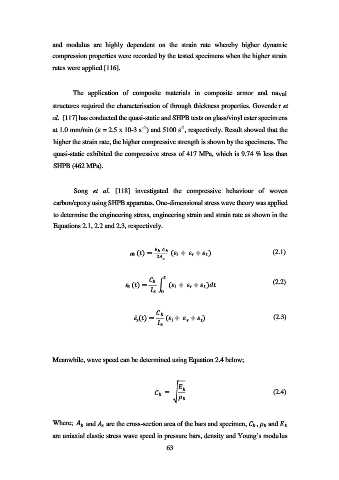
                           Song  et  al.  [118]  investigated  the  compressive  behaviour  of  woven

                   carbon/epoxy using SHPB apparatus. One-dimensional stress wave theory was applied
                   to determine the engineering stress, engineering strain and strain rate as shown in the

                   Equations 2.1, 2.2 and 2.3, respectively.


                                                 (  ) =                 (   +    +    )          (2.1)


                                                        2


                                                (  ) =       ∫   (   +    +    )                 (2.2)


                                                            0


                                                  ̇ (  ) =  (   +    +    )                      (2.3)


                   Meanwhile, wave speed can be determined using Equation 2.4 below;


                                                          = √                                    (2.4)


                   Where;      and     are the cross-section area of the bars and specimen,    ,     and


                   are uniaxial elastic stress wave speed in pressure bars, density and Young’s modulus
                                                           63

