


Page 90 - Template Tesis UTM v2.0
P. 90
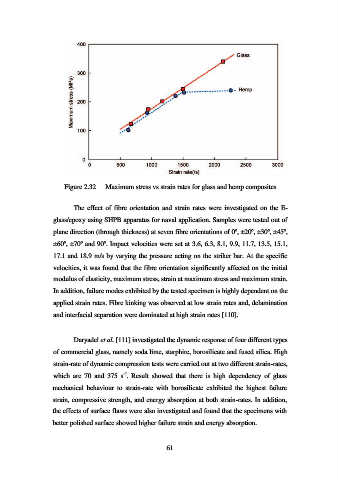
Figure 2.32    Maximum stress vs strain rates for glass and hemp composites


                           The  effect  of  fibre  orientation  and  strain  rates  were  investigated  on  the  E-
                   glass/epoxy using SHPB apparatus for naval application. Samples were tested out of

                   plane direction (through thickness) at seven fibre orientations of 0º, ±20º, ±30º, ±45º,

                   ±60º, ±70º and 90º. Impact velocities were set at 3.6, 6.3, 8.1, 9.9, 11.7, 13.5, 15.1,
                   17.1 and 18.9 m/s by varying the pressure acting on the striker bar. At the specific

                   velocities, it was found that the fibre orientation significantly affected on the initial
                   modulus of elasticity, maximum stress, strain at maximum stress and maximum strain.

                   In addition, failure modes exhibited by the tested specimen is highly dependent on the

                   applied strain rates. Fibre kinking was observed at low strain rates and, delamination
                   and interfacial separation were dominated at high strain rates [110].


                           Daryadel et al. [111] investigated the dynamic response of four different types
                   of commercial glass, namely soda lime, starphire, borosilicate and fused silica. High

                   strain-rate of dynamic compression tests were carried out at two different strain-rates,
                                            -1
                   which  are  70  and  375  s .  Result  showed  that  there  is  high  dependency  of  glass
                   mechanical  behaviour  to  strain-rate  with  borosilicate  exhibited  the  highest  failure

                   strain, compressive strength, and energy absorption at both strain-rates. In addition,
                   the effects of surface flaws were also investigated and found that the specimens with

                   better polished surface showed higher failure strain and energy absorption.


                                                           61

