Page 42 - Spotlight A+ Form 4 & 5 Chemistry KSSM
P. 42
Form
           5          Chemistry   Chapter 1 Redox Equilibrium

        CHAP.       (v)  Write the ionic equation to represent the reaction that take place in test tube P.   C3    [1 mark]                                                                                             CHAP.
         1       (b)  1,1,1-trichloromethane is added to test tubes P and Q. The mixture in both test tubes are shaken gently.                                                                                            1

                    (i)  Predict the colour of 1,1,1-trichloromethane in both test tubes.   C4    [1 mark]
                    (ii)  Explain the formation of the colour of 1,1,1-trichloromethane in test tube Q.   C3    [1 mark]


                                                      Section B

             SPM CLONE
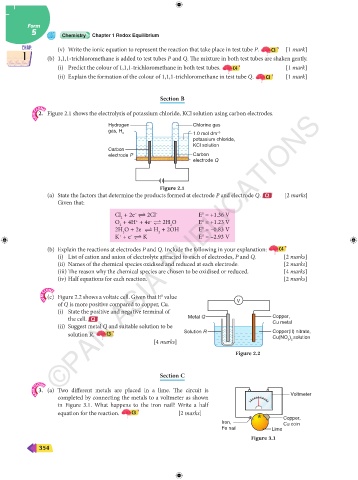
              2.  Figure 2.1 shows the electrolysis of potassium chloride, KCl solution using carbon electrodes.
                    ©PAN ASIA PUBLICATIONS
                                     Hydrogen                   Chlorine gas
                                     gas, H
                                         2                      1.0 mol dm –3
                                                                potassium chloride,
                                                                KCl solution
                                     Carbon
                                     electrode P                Carbon
                                                                electrode Q


                                                      Figure 2.1
                 (a)  State the factors that determine the products formed at electrode P and electrode Q.  C2  [2 marks]
                    Given that:
                                       Cl  + 2e   2Cl –          E  = +1.36 V
                                             –
                                                                   0
                                         2
                                       O  + 4H  + 4e   2H O      E  = +1.23 V
                                              +
                                                  –
                                                                   0
                                                         2
                                        2
                                       2H O + 2e   H  + 2OH –    E  = –0.83 V
                                               –
                                                                   0
                                         2
                                                     2
                                       K  + e   K                E  = –2.93 V
                                            –
                                                                   0
                                        +
                 (b)  Explain the reactions at electrodes P and Q. Include the following in your explanation:   C4
                    (i)  List of cation and anion of electrolyte attracted to each of electrodes, P and Q.   [2 marks]
                    (ii)  Names of the chemical species oxidised and reduced at each electrode.   [2 marks]
                    (iii) The reason why the chemical species are chosen to be oxidised or reduced.   [4 marks]
                    (iv) Half equations for each reaction.                                    [2 marks]
                SPM CLONE                             0
                 (c)  Figure 2.2 shows a voltaic cell. Given that E  value
                    of Q is more positive compared to copper, Cu.              V
                    (i)  State the positive and negative terminal of
                       the cell.  C2                           Metal Q                    Copper,
                    (ii)  Suggest metal Q and suitable solution to be                     Cu metal
                       solution R.   C3                      Solution R                   Copper(II) nitrate,
                                                                                          Cu(NO ) solution
                                                   [4 marks]                                   3 2
                                                                              Figure 2.2
                                                     Section C
             SPM CLONE
              3.  (a)  Two different metals are placed in a lime. The circuit is
                    completed by connecting the metals to a voltmeter as shown                  Voltmeter
                    in Figure 3.1. What happens to the iron nail? Write a half
                    equation for the reaction.   C3        [2 marks]
                                                                                              Copper,
                                                                          Iron,               Cu coin
                                                                          Fe nail         Lime
                                                                                   Figure 3.1
              354
   37   38   39   40   41   42   43   44   45   46   47