


Page 15 - 1202 Question Bank Chemistry Form 5 KSSM
P. 15
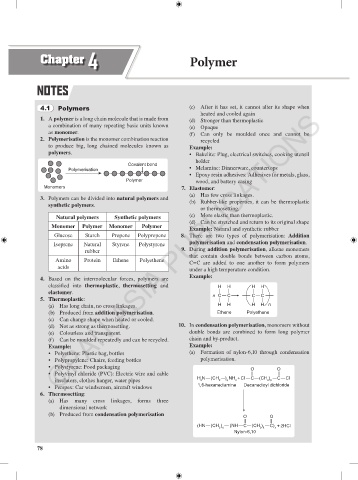
4
               Chapter                                              Polymer


              NOTES


               4.1   Polymers                                       (c)  After it has set, it cannot alter its shape when
                                                                        heated and cooled again
                      ©PAN ASIA PUBLICATIONS
                1.  A polymer is a long chain molecule that is made from   (d)  Stronger than thermoplastic
                  a combination of many repeating basic units known   (e)  Opaque
                  as monomer.                                       (f)  Can only be moulded once and cannot be
                2.  Polymerisation is the monomer combination reaction   recycled
                  to produce big, long chained molecules known as   Example:
                  polymers.                                         •  Bakelite: Plug, electrical switches, cooking utensil
                                                                      holder
                                              Covalent bond
                         Polymerisation                             •  Melamine: Dinnerware, countertops
                                                                    •  Epoxy resin adhesives: Adhesives for metals, glass,
                                              Polymer                 wood, and battery casing
                 Monomers                                         7.  Elastomer:
                                                                    (a)  Has few cross linkages.
                3.  Polymers can be divided into natural polymers and   (b)  Rubber-like properties, it can be thermoplastic
                  synthetic polymers.
                                                                        or thermosetting.
                     Natural polymers     Synthetic polymers        (c)  More elastic than thermoplastic.
                                                                    (d)  Can be stretched and return to its original shape
                   Monomer    Polymer   Monomer    Polymer
                                                                    Example: Natural and synthetic rubber
                    Glucose    Starch    Propene  Polypropene     8.  There  are  two types of polymerisation:  Addition
                    Isoprene   Natural   Styrene  Polystyrene       polymerisation and condensation polymerisation.
                               rubber                             9.  During addition polymerisation, alkene monomers
                                                                    that contain double bonds between carbon atoms,
                     Amino     Protein   Ethene    Polyethene       C=C are added to one another to form polymers
                     acids
                                                                    under a high temperature condition.
                                                                     Example:
                4.  Based on the intermolecular forces, polymers  are
                  classified  into  thermoplastic,  thermosetting  and        H   H       H  H
                  elastomer.
                                                                            n C   C       C  C
                5.  Thermoplastic:
                  (a)  Has long chain, no cross linkages.                     H   H       H  H n
                  (b)  Produced from addition polymerisation.                 Ethene    Polyethene
                  (c)  Can change shape when heated or cooled.
                  (d)  Not as strong as thermosetting.           10.  In condensation polymerisation, monomers without
                  (e)  Colourless and transparent.                  double bonds are combined to form long polymer
                  (f)  Can be moulded repeatedly and can be recycled.  chain and by-product.
                  Example:                                           Example:
                  •  Polyethene: Plastic bag, bottles               (a)  Formation of nylon-6,10 through condensation
                  •  Polypropylene: Chairs, feeding bottles             polymerisation.
                  •  Polystyrene: Food packaging
                                                                                          O        O
                  •  Polyvinyl chloride (PVC): Electric wire and cable
                                                                       H N  (CH  ) NH + Cl  C  (CH )  C  Cl
                    insulators, clothes hanger, water pipes             2      2  6  2          2 8
                  •  Perspex: Car windscreen, aircraft windows         1,6-hexanediamine  Decanedioyl dichloride
                6.  Thermosetting:
                  (a)  Has many cross linkages, forms three
                      dimensional network
                  (b)  Produced from condensation polymerisation
                                                                                       O         O
                                                                       (HN  (CH )  (NH  C  (CH )  C )  + 2HCl
                                                                               2 6           2 8  n
                                                                                    Nylon-6,10

              78

