


Page 12 - 1202 Question Bank Chemistry Form 5 KSSM
P. 12
PAPER 1
Each question is followed by four options A, B, C or D . Choose the best option for each question.
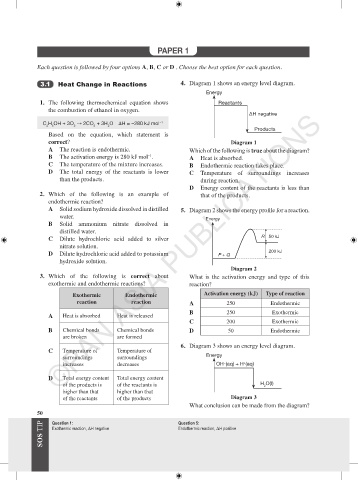
3.1 Heat Change in Reactions 4. Diagram 1 shows an energy level diagram.
Energy
1. The following thermochemical equation shows Reactants
the combustion of ethanol in oxygen.
©PAN ASIA PUBLICATIONS
ΔH negative
C H OH + 3O → 2CO + 3H O H = −280 kJ mol −1
2 5 2 2 2
Products
Based on the equation, which statement is
correct? Diagram 1
A The reaction is endothermic. Which of the following is true about the diagram?
−1
B The activation energy is 280 kJ mol . A Heat is absorbed.
C The temperature of the mixture increases. B Endothermic reaction takes place.
D The total energy of the reactants is lower C Temperature of surroundings increases
than the products. during reaction.
D Energy content of the reactants is less than
2. Which of the following is an example of that of the products.
endothermic reaction?
A Solid sodium hydroxide dissolved in distilled 5. Diagram 2 shows the energy profile for a reaction.
water.
Energy
B Solid ammonium nitrate dissolved in
distilled water.
C Dilute hydrochloric acid added to silver R 50 kJ
nitrate solution.
D Dilute hydrochloric acid added to potassium P + Q 200 kJ
hydroxide solution.
Diagram 2
3. Which of the following is correct about What is the activation energy and type of this
exothermic and endothermic reactions? reaction?
Exothermic Endothermic Activation energy (kJ) Type of reaction
reaction reaction A 250 Endothermic
B 250 Exothermic
A Heat is absorbed Heat is released
C 200 Exothermic
B Chemical bonds Chemical bonds D 50 Endothermic
are broken are formed
6. Diagram 3 shows an energy level diagram.
C Temperature of Temperature of
surroundings surroundings Energy
−
increases decreases OH (aq) + H (aq)
+
D Total energy content Total energy content
of the products is of the reactants is H O(l)
2
higher than that higher than that
of the reactants of the products Diagram 3
What conclusion can be made from the diagram?
50 Question 1: Question 5:
SOS TIP Exothermic reaction, ΔH negative Endothermic reaction, ΔH positive

