Page 11 - 1202 Question Bank Chemistry Form 5 KSSM
P. 11
3
                   Chapter                                     Thermochemistry


                  NOTES


                   3.1   Heat Change in Reactions
                      ©PAN ASIA PUBLICATIONS
                                    Exothermic reactions                        Endothermic reactions

                         1.  Reaction that  releases heat  energy to the    1.  Reaction that absorbs heat energy from the
                           surroundings.                                 surroundings.
                         2.  Energy content of reactants is higher than that    2.  Energy content of products is higher than that
                           of products.                                  of reactants.
                         3.  ΔH has a negative value.                  3.  ΔH has a positive value.
                         4.  Heat  released  to  the  surroundings,  the    4.  Temperature of solution decreases.
                           surrounding temperature increases.          5.  Container feels cold.
                         5.  Container feels hot.                      6.  Example:
                            Example:                                     (a)  Ammonium salt dissolves in water.
                           (a)  Neutralisation of acid by alkali
                                                                             NH NO (s) → NH (aq) + NO (aq)
                                                                                                    −
                                                                                           +
                                                                               4   3      4        3
                            NaOH(aq) + HCl(aq) → NaCl(aq) + H O(l)
                                                          2
                           (b)  Combustion of fuel                       (b)  Hydrated salt is decomposed by heat to form
                                                                             anhydrous salt.
                             C H OH(l) + 3O (g) → 2CO (g) + 3H O(l)
                              2  5       2        2      2
                           (c)  Displacement of copper from copper(II)       CuSO .5H O →  CuSO  + 5H O
                                                                                         
                                                                                                4
                                                                                  4
                                                                                      2
                                                                                                     2
                               sulphate solution by zinc metal.
                                                                         (c)  Heat decomposition.
                             Zn(s) + CuSO (ak) → ZnSO (ak) + Cu(s)
                                        4          4
                           (d)  Precipitation of silver chloride insoluble salt.  CaCO  →  CaO + CO 2
                                                                                        
                                                                                      3
                            AgNO (aq) + HCl(aq) → AgCl(l) + HNO (aq)
                                 3                         3
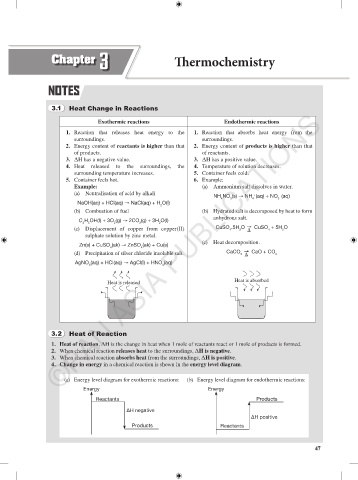
                                                                                    Heat is absorbed
                                       Heat is released


                   3.2   Heat of Reaction

                    1.  Heat of reaction, ΔH is the change in heat when 1 mole of reactants react or 1 mole of products is formed.
                    2.  When chemical reaction releases heat to the surroundings, ΔH is negative.
                    3.  When chemical reaction absorbs heat from the surroundings, ΔH is positive.
                    4.  Change in energy in a chemical reaction is shown in the energy level diagram.


                        (a)  Energy level diagram for exothermic reactions:   (b)  Energy level diagram for endothermic reactions:
                               Energy                                      Energy
                                   Reactants                                                Products
                                              ΔH negative
                                                                                          ΔH positive
                                                Products                       Reactants


                                                                                                                 47
   6   7   8   9   10   11   12   13   14   15   16