


Page 13 - 1202 Question Bank Chemistry Form 5 KSSM
P. 13
PAPER 2


                                                         Section A

              Answer all questions.

                                                                                                              3
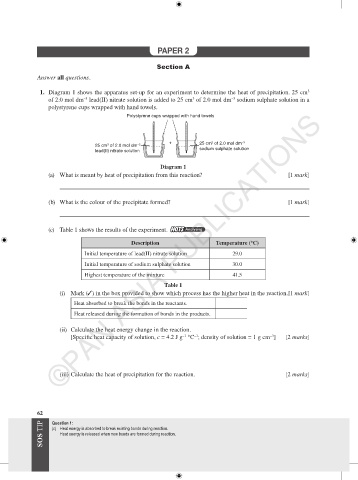
                1.  Diagram 1 shows the apparatus set-up for an experiment to determine the heat of precipitation. 25 cm
                                                                                   −3
                                                                     3
                               −3
                  of 2.0 mol dm  lead(II) nitrate solution is added to 25 cm  of 2.0 mol dm  sodium sulphate solution in a
                  polystyrene cups wrapped with hand towels.
                      ©PAN ASIA PUBLICATIONS
                                              Polystyrene cups wrapped with hand towels

                                                                            3
                                                                                       −3
                                                             +          25 cm  of 2.0 mol dm
                                       3
                                                  −3
                                   25 cm  of 2.0 mol dm
                                   lead(II) nitrate solution            sodium sulphate solution
                                                          Diagram 1
                  (a)  What is meant by heat of precipitation from this reaction?                      [1 mark]


                  (b)  What is the colour of the precipitate formed?                                   [1 mark]


                  (c)  Table 1 shows the results of the experiment.  HOTS Analysing

                                                Description                   Temperature (°C)

                               Initial temperature of lead(II) nitrate solution    29.0
                               Initial temperature of sodium sulphate solution     30.0
                               Highest temperature of the mixture                  41.5

                                                           Table 1
                      (i)  Mark (3) in the box provided to show which process has the higher heat in the reaction. [1 mark]

                           Heat absorbed to break the bonds in the reactants.
                           Heat released during the formation of bonds in the products.

                      (ii)  Calculate the heat energy change in the reaction.
                                                                      −1
                                                                                                 −3
                                                                  −1
                          [Specific heat capacity of solution, c = 4.2 J g  °C ; density of solution = 1 g cm ]   [2 marks]


                      (iii) Calculate the heat of precipitation for the reaction.                     [2 marks]


              62   Question 1:
                SOS TIP  (c)  Heat energy is absorbed to break existing bonds during reaction.
                      Heat energy is released when new bonds are formed during reaction.

