


Page 13 - 1202 Question Bank Chemistry Form 4 KSSM
P. 13
Section B

               7.  (a)  The following chemical equation shows the burning of carbon.
            SPM
            SPM
             CLONE
                                                      2C(s) + O (g) → 2CO(g)
                                                            2
                     Based on the equation, give two qualitative information and one quantitative information.   [3 marks]
                (b)  A hydrocarbon X, consists of 82.75 % of carbon and 17.25 % of hydrogen by mass. The relative molecular mass
                     of X is 58.
                     (i)  Determine the empirical formula of hydrocarbon X.                           [4 marks]
                     (ii)  What is the molecular formula of hydrocarbon X.                            [2 marks]
                      ©PAN ASIA PUBLICATIONS
                (c)  A good fertiliser will have a higher percentage of nitrogen by mass. Below are two types of fertilisers.

                                                 Urea, CO(NH )       (NH ) PO 4
                                                           2 2
                                                                    4 3
                     Compare the percentage of nitrogen by mass for these fertilisers. Then, identify and explain which fertiliser is a
                     better fertiliser. HOTS Applying                                                 [6 marks]
                     [Relative atomic mass: H = 1, C = 12, N = 14, O = 16, P = 31]


                                                        Section C

               8.  (a)  The relative atomic mass of an atom of element is compared with the standard atom. HOTS Applying
                     Using the idea above, find the
                     (i)  number of times 2 bromine atoms are heavier compared to 5 oxygen atoms.
                         [Relative atomic mass: O = 16; Br = 80;]
                     (ii)  number of carbon atoms that have the same mass as 2 krypton atoms.
                         [Relative atomic mass: C = 12; Kr = 84]                                      [4 marks]
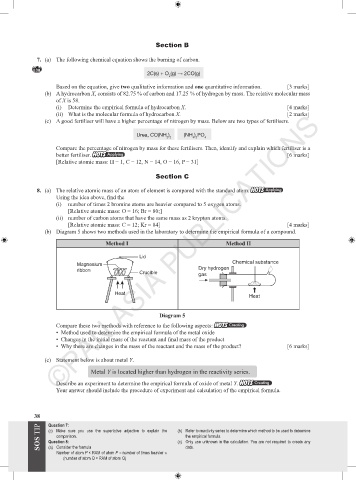
                (b)  Diagram 5 shows two methods used in the laboratory to determine the empirical formula of a compound.
                                      Method I                                  Method II


                                                  Lid
                                                                                  Chemical substance
                            Magnesium
                            ribbon                                    Dry hydrogen
                                                  Crucible            gas


                                         Heat
                                                                                        Heat

                                                         Diagram 5
                     Compare these two methods with reference to the following aspects: HOTS Creating
                     •  Method used to determine the empirical formula of the metal oxide
                     •  Changes in the initial mass of the reactant and final mass of the product
                     •  Why there are changes in the mass of the reactant and the mass of the product?   [6 marks]

                (c)  Statement below is about metal Y.
                                 Metal Y is located higher than hydrogen in the reactivity series.

                     Describe an experiment to determine the empirical formula of oxide of metal Y. HOTS Creating
                     Your answer should include the procedure of experiment and calculation of the empirical formula.


             38   Question 7:
               SOS TIP  (c)  Make  sure you use the superlative  adjective  to explain  the   (b)  Refer to reactivity series to determine which method to be used to determine
                                                                  the empirical formula.
                     comparison.
                                                               (c)  Only use unknown in the calculation. You are not required to create any
                  Question 8:
             38   (a)  Consider the formula                       data.
                     Number of atom P × RAM of atom P = number of times heavier ×
                       (number of atom Q × RAM of atom Q)

