


Page 15 - 1202 Question Bank Chemistry Form 4 KSSM
P. 15
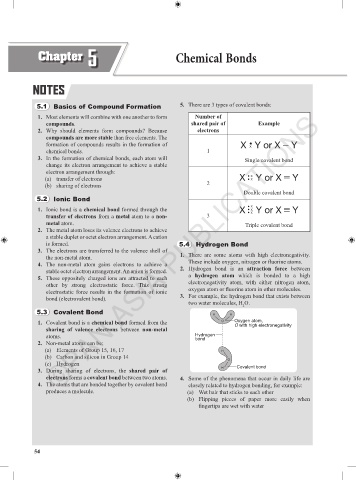
5                               Chemical Bonds
              Chapter


             NOTES


              5.1   Basics of Compound Formation                 5.  There are 3 types of covalent bonds:

                      ©PAN ASIA PUBLICATIONS
               1.  Most elements will combine with one another to form   Number of
                 compounds.                                         shared pair of         Example
               2.  Why should elements  form compounds?  Because      electrons
                 compounds are more stable than free elements. The
                 formation of compounds results in the formation of                  X  X Y or X   Y
                 chemical bonds.                                         1
               3.  In the formation of chemical bonds, each atom will                  Single covalent bond
                 change its electron arrangement to achieve a stable
                 electron arrangement through:
                (a)  transfer of electrons                                           X  X Y or X   Y
                                                                                         X
                (b)  sharing of electrons                                2
                                                                                      Double covalent bond
              5.2   Ionic Bond

                                                                                         X
               1.  Ionic bond is a chemical bond formed through the                  X  X Y or X   Y
                                                                                         X
                 transfer of electrons from a metal atom to a non-       3
                 metal atom.                                                           Triple covalent bond
               2.  The metal atom loses its valence electrons to achieve
                 a stable duplet or octet electron arrangement. A cation
                 is formed.                                     5.4   Hydrogen Bond
               3.  The electrons are transferred to the valence shell of
                 the non-metal atom.                             1.  There are some atoms with high electronegativity.
               4.  The  non-metal  atom  gains electrons  to  achieve  a   These include oxygen, nitrogen or fluorine atoms.
                 stable octet electron arrangement. An anion is formed.    2.  Hydrogen bond is an  attraction  force between
               5.  These oppositely charged ions are attracted to each   a  hydrogen atom which is bonded to a high
                 other by strong electrostatic  force.  This strong   electronegativity  atom,  with  either  nitrogen  atom,
                 electrostatic  force results in the formation of ionic   oxygen atom or fluorine atom in other molecules.
                 bond (electrovalent bond).                      3.  For example, the hydrogen bond that exists between
                                                                   two water molecules, H O.
                                                                                      2
              5.3   Covalent Bond                                          H     H

               1.  Covalent bond is a chemical bond formed from the            O   Oxygen atom,
                                                                                   O with high electronegativity
                 sharing of valence electrons between  non-metal
                 atoms.                                              Hydrogen
               2.  Non-metal atoms can be:                           bond
                (a)  Elements of Group 15, 16, 17                             H
                (b)  Carbon and silicon in Group 14                              O
                (c)  Hydrogen
               3.  During sharing  of electrons,  the  shared pair of         H     Covalent bond
                 electrons forms a covalent bond between two atoms.    4.  Some of the phenomena that occur in daily life are
               4.  The atoms that are bonded together by covalent bond   closely related to hydrogen bonding, for example:
                 produces a molecule.                             (a)  Wet hair that sticks to each other
                                                                  (b)  Flipping  pieces  of paper more  easily  when
                                                                       fingertips are wet with water


             54

