


Page 12 - Listing Presentation
P. 12
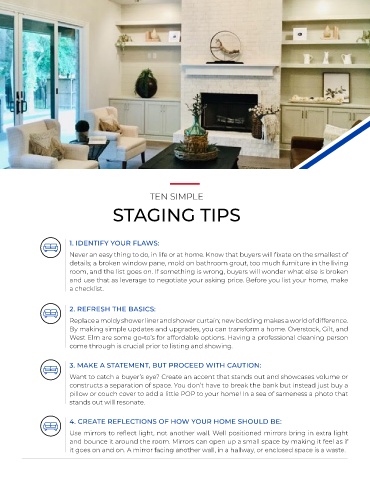
STAGING TIPS - (Continued)


                                                                                                                                                  5. STORAGE WARS:
                                                                                                                                                  Store your off-season wardrobe in a trunk or consider renting space at a storage facility. You
                                                                                                                                                  should clear out all unnecessary items: throw out products in your bathroom vanity and
                                                                                                                                                  kitchen cabinets that you never use, and just empty out as much as possible. Showcase
                                                                                                                                                  how much space the buyer will have if they move in. And while you’re at it, arrange your
                                                                                                                                                  clothes by color, it will help everything look more organized and efficient.


                                                                                                                                                  6. GET TRASHED:

                                                                                                                                                  Remove ALL trash and recycling. Trash should NEVER be out in the open for buyers to
                                                                                                                                                  see. It’s garbage, not artwork and definitely make sure it’s all been removed before you
                                                                                                                                                  photograph the listing. If you have an unattractive trash receptacle, get rid of it. Consider
                                                                                                                                                  instead using something you already have: a vase, wine bucket, an unused piece of pottery,
                                                                                                                                                  a magazine bucket, etc.

                                                   TEN SIMPLE                                                                                     7. FLOWERS ARE GREAT, BUT...

                                      STAGING TIPS                                                                                                they are expensive and only last a few days. Consider easy to maintain plants to add life,
                                                                                                                                                  color, and a sense of calm to your home. Succulents, air plants, bamboo, ferns, and orchids
                                                                                                                                                  are ideal and easily found at bodegas and grocery stores. If you have very high ceilings,
                                                                                                                                                  consider using blooming branches in a long glass vase elevated above four feet to showcase
                        1. IDENTIFY YOUR FLAWS:                                                                                                   the ceiling height. (Good) Fake plants and flowers also work great for photography, plus no
                                                                                                                                                  one will know the difference!
                        Never an easy thing to do, in life or at home. Know that buyers will fixate on the smallest of
                        details; a broken window pane, mold on bathroom grout, too much furniture in the living                                   8. VIRTUAL REALITY:
                        room, and the list goes on. If something is wrong, buyers will wonder what else is broken
                        and use that as leverage to negotiate your asking price. Before you list your home, make                                  Selling an empty property? Consider having it virtually staged to make the images more
                        a checklist.                                                                                                              interesting. An empty apartment looks bland and small. If you don’t want to stage it with
                                                                                                                                                  real furniture, you should at the very least have it virtually staged with a design scheme
                                                                                                                                                  that is representative of the apartment, building, neighborhood, and price point. You also
                        2. REFRESH THE BASICS:
                                                                                                                                                  have to understand your demographic. A loft in Williamsburg would look absurd filled
                        Replace a moldy shower liner and shower curtain; new bedding makes a world of difference.                                 with traditional furniture associated with the suburbs
                        By making simple updates and upgrades, you can transform a home. Overstock, Gilt, and
                        West Elm are some go-to’s for affordable options. Having a professional cleaning person                                   9. THE KITCHEN CONUNDRUM:
                        come through is crucial prior to listing and showing.
                                                                                                                                                  A cluttered counter is distracting in pictures. Make sure you hide all of those sponges,
                                                                                                                                                  cleaning solutions, kitchen rags, and excess in all corners of your kitchen. If you just renovated
                        3. MAKE A STATEMENT, BUT PROCEED WITH CAUTION:
                                                                                                                                                  your kitchen or bathroom, showcase the with a few attractive and high end products, but
                        Want to catch a buyer’s eye? Create an accent that stands out and showcases volume or                                     sparingly. Buyers will expect to see Molton rown, not Dial soap on a Waterworks sink.
                        constructs a separation of space. You don’t have to break the bank but instead just buy a
                        pillow or couch cover to add a little POP to your home! In a sea of sameness a photo that                                 10. MAKE SCENTS:
                        stands out will resonate.
                                                                                                                                                  Air  out  your  home  at  least  24  hours  before  you  are  showing  -  that  means  open  every
                                                                                                                                                  window. If there is a litter box, remove it before showing. Got a dog? Give him a bath.
                        4. CREATE REFLECTIONS OF HOW YOUR HOME SHOULD BE:                                                                         Fabrics capture smells, which can work to your benefit. One of my favorite “recipes” is
                        Use mirrors to reflect light, not another wall. Well positioned mirrors bring in extra light                              adding a little essential oil (lavender, eucalyptus, orange, and grapefruit) to a spray bottle
                        and bounce it around the room. Mirrors can open up a small space by making it feel as if                                  filled with water. I used this concoction to spray down every piece of cloth furniture and all
                        it goes on and on. A mirror facing another wall, in a hallway, or enclosed space is a waste.                              the curtains in every room three hours before an open house.

