


Page 38 - 2010-2022 hose manufactureing ability and guide
P. 38
Of the three flexible mandrel  styles, solid   Manufacturing with  rigid mandrels  offers
                 rubber offers  minimal support, while rubber   two  unique production opportunities.  Rigid
                 with  wire core and  thermoplastic versions    mandrels  can  be (1) rotated  on a  stationary
                 provide good dimensional control. In all cases,   horizontal axis,  similar to a  lathe, so  that
                 the flexible mandrel is removed from the hose   material can be applied in bias style or (2) fed
                 with  either  hydrostatic  pressure or mechanical   horizontally through the tubing, reinforcing and
                 push/pull after processing. The mandrel is then   covering  operations as the  various  hose
                 inspected for  dimensional and cosmetic        components  are  spirally fed onto  the mandrel.
                 imperfections, rejoined into a continuous length,   The former method is often referred to as Hand
                 and recycled into  the  hose making process.   Built hose. The reference of Wrapped Ply hose
                 Although the flexible  mandrel  is  continuous,   can  be associated with either method. Some
                 limitations of expulsion from the finished hose   hand built hoses, depending on the application,
                 rarely allow hose lengths above 1000 ft.  Either   have special ends to accommodate  its
                 textile or wire reinforcements  may  be  used.   attachment  to existing flanges in the field.
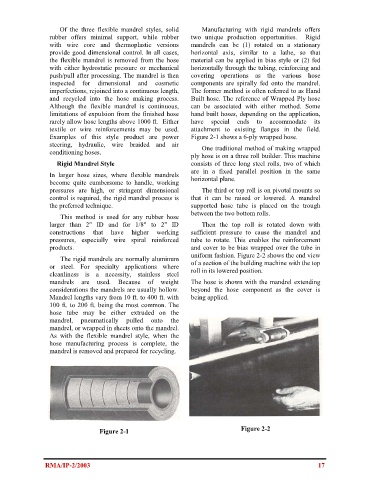
                 Examples of  this style  product  are power    Figure 2-1 shows a 6-ply wrapped hose.
                 steering, hydraulic, wire braided and air          One traditional method of making wrapped
                 conditioning hoses.
                                                                ply hose is on a three roll builder. This machine
                    Rigid Mandrel Style                         consists of three long steel rolls, two of which
                                                                are  in a  fixed parallel  position in the  same
                 In  larger  hose sizes, where flexible  mandrels
                 become quite cumbersome to  handle,  working   horizontal plane.
                 pressures are high,  or stringent dimensional      The third or top roll is on pivotal mounts so
                 control is required, the rigid mandrel process is   that it can be raised  or lowered. A mandrel
                 the preferred technique.                       supported  hose tube  is placed  on the trough
                                                                between the two bottom rolls.
                     This method is used for  any rubber  hose
                 larger  than  2" ID and  for 1/8"  to  2" ID       Then  the  top  roll  is rotated down with
                 constructions that  have higher working        sufficient pressure to  cause the  mandrel  and
                 pressures,  especially  wire spiral reinforced   tube  to rotate. This enables  the reinforcement
                 products.                                      and cover to be bias wrapped over the tube in
                                                                uniform fashion. Figure 2-2 shows the end view
                     The rigid mandrels are normally aluminum
                 or  steel. For specialty  applications  where   of a section of the building machine with the top
                 cleanliness  is a necessity, stainless  steel   roll in its lowered position.
                 mandrels are used.  Because  of weight         The hose is shown with the mandrel extending
                 considerations the mandrels are usually hollow.   beyond  the hose component as  the cover  is
                 Mandrel lengths vary from 10 ft. to 400 ft. with   being applied.
                 100 ft. to 200 ft. being the most common. The
                 hose tube may be either extruded  on  the
                 mandrel,  pneumatically pulled  onto the
                 mandrel, or wrapped in sheets onto the mandrel.
                 As with the  flexible  mandrel style, when  the
                 hose manufacturing process  is complete, the
                 mandrel is removed and prepared for recycling.


                                  Figure 2-1                                     Figure 2-2


                RMA/IP-2/2003                                                                             17

