


Page 40 - 2010-2022 hose manufactureing ability and guide
P. 40
Continuous Systems                             Extruded Tubes

                     To minimize  handling inventory and  cost      For the tube extrusion process, an uncured
                 while maximizing throughput,  the continuous   rubber  or thermoplastic  compound ribbon  or
                 process  is common. This process  combines     pellets are  fed into  the extruder,  through  the
                 tubing, reinforcing, covering and vulcanization   screw or auger with proper temperature controls
                 into a single process. To do this, the equipment   and finally forced through a pair of metal dies,
                 is merely installed in a tandem fashion thereby   where the cylindrical tube is formed. In the non-
                 enabling the hose material to flow uninterrupted   continuous process,  the tube  is  then  cooled,
                 through each phase.  Obviously  the system     lubricated to minimize tackiness, and stored in
                 controls  are vitally important  to minimize   coils on pans, reels, or rigid mandrel poles.
                 downtime. Since  the line  output  is generally    Dimensional control is critical when the
                 limited by the reinforcement  unit capacity,   tube is being formed. Traditional techniques for
                 textile spiraling is the common approach. Also,   maintaining dimensions include die selection,
                 since  the  vulcanization portion of  the  line  is   temperature, and line  speed  adjustments. The
                 often the most space consuming and expensive,   latest innovations  include  a multi-axis laser
                 it is frequently not included. Hoses up to 2" ID with   micrometer measuring  the tube  outer diameter
                 working-pressures  up to  400 psi are the most   with  feedback to the  extruder to provide size
                 probable candidates  for this  process.  Flexible   control. Ultrasonic  devices, that can measure
                 mandrel  or non-mandrel methods can  be        tube ID and OD, are also available. Figure 2-6
                 accommodated  on the continuous process.       shows  the  tube  being formed  as it comes
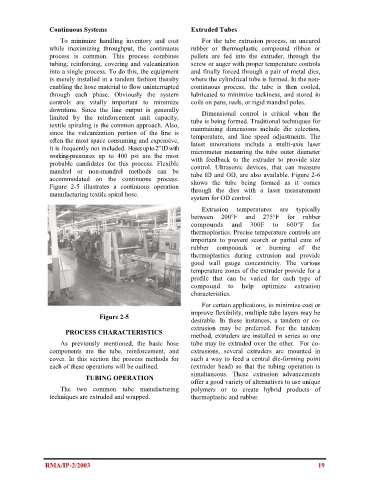
                 Figure  2-5 illustrates a continuous operation   through the  dies with a laser measurement
                 manufacturing textile spiral hose.
                                                                system for OD control.
                                                                    Extrusion temperatures are  typically
                                                                between 200°F  and 275°F for  rubber
                                                                compounds and 300F to  600°F  for
                                                                thermoplastics. Precise temperature controls are
                                                                important to  prevent scorch or partial  cure  of
                                                                rubber compounds or  burning  of  the
                                                                thermoplastics during extrusion and provide
                                                                good wall gauge concentricity. The various
                                                                temperature zones of the extruder provide for a
                                                                profile  that can  be  varied for each  type of
                                                                compound to help optimize extrusion
                                                                characteristics.
                                                                    For certain applications, to minimize cost or
                                                                improve flexibility, multiple tube layers may be
                                  Figure 2-5
                                                                desirable. In these instances, a  tandem or co-
                                                                extrusion may  be preferred. For the  tandem
                       PROCESS CHARACTERISTICS
                                                                method, extruders are installed in series so one
                     As  previously  mentioned, the  basic hose   tube may be extruded over the other.  For co-
                 components are  the tube, reinforcement,  and   extrusions,  several extruders are mounted  in
                 cover. In  this section the  process methods for   such a way to feed a central die-forming point
                 each of these operations will be outlined.     (extruder head)  so that  the  tubing  operation is
                                                                simultaneous. These  extrusion advancements
                             TUBING OPERATION
                                                                offer a good variety of alternatives to use unique
                     The  two common tube manufacturing         polymers or to create hybrid products  of
                 techniques are extruded and wrapped.           thermoplastic and rubber.


                RMA/IP-2/2003                                                                             19

