


Page 43 - 2010-2022 hose manufactureing ability and guide
P. 43
Rotary Type                                    Each strand of reinforcement is fed through an
                                                                array of tensioning devices to the center point of
                     The term rotary braider applies  to  units
                 where the  carriers  holding the  reinforcement   the decks where they are applied to the tube in a
                 package are fixed on two counter-rotating decks   parallel array.  In  all  cases, to have  a balanced
                 and do not move in and out in a serpentine path   hose construction capable of minimal distortion
                                                                under pressure, the spirals are always in
                 like the  maypole  type. The braiding pattern  is
                 achieved by deflecting the reinforcement       multiples of two.    Because  of the minimal
                 strands from the  outside  deck  under and  over   number  of moving parts,  the spiral decks  can
                                                                turn at  very high rates. State-of-the-art  textile
                 two carriers on  the inside deck,  repeating the
                 motion continuously during rotation. Because of   spiral  units, available at 2000  rpm  are
                 the simpler travel of the carriers, output speeds   commonly used in continuous lines where
                                                                tubing, reinforcing and covering are all done in
                 can  be  as much  as  200% faster than an
                 equivalent maypole type. Common                one pass. Textile spiral is well suited for non-
                 arrangements  are  available  in 20, 24, 36, 48   mandrel or flexible mandrel constructions, with
                                                                low to medium pressure ratings. Wire spiral is
                 carriers, vertical  and  horizontal, one-,  two- or
                 three-deck  setups for both textile  and wire   most common on rigid mandrel designs up to 2"
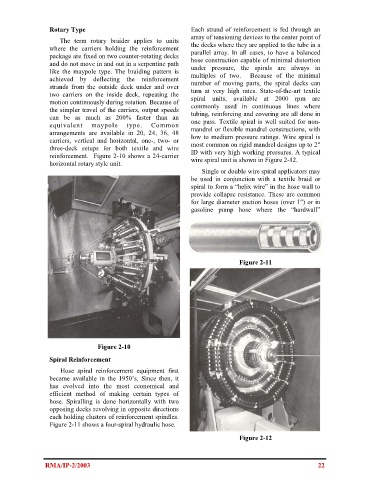
                 reinforcement.  Figure 2-10 shows a 24-carrier   ID with very high working pressures. A typical
                                                                wire spiral unit is shown in Figure 2-12.
                 horizontal rotary style unit.
                                                                       Single or double wire spiral applicators may
                                                                be used  in  conjunction  with a textile braid  or
                                                                spiral to form a “helix wire” in the hose wall to
                                                                provide collapse resistance. These are common
                                                                for large diameter suction hoses (over 1") or in
                                                                gasoline pump hose  where the  “hardwall”


                                                                                Figure 2-11


                                 Figure 2-10
                 Spiral Reinforcement

                     Hose spiral  reinforcement equipment  first
                 became available in the  1950’s.  Since  then,  it
                 has evolved into  the  most  economical and
                 efficient method of making certain  types of
                 hose. Spiralling is  done  horizontally with  two
                 opposing decks revolving in opposite directions
                 each holding clusters of reinforcement spindles.
                 Figure 2-11 shows a four-spiral hydraulic hose.

                                                                                Figure 2-12


                RMA/IP-2/2003                                                                             22

