


Page 42 - 2010-2022 hose manufactureing ability and guide
P. 42
When  multiple  plies of reinforcement  are    Vertical set-ups are normally a maximum of
                 required to meet working pressure performance   two decks for convenience and  handle  non-
                 levels,  typically they  are applied  one over  the   mandrel or flexible mandrel hoses up to 1-1/2"
                 other  normally separated with a  rubber layer   ID. For vertical braiding, the tube is fed into the
                 (friction or jacket) to fill voids, prevent adjacent   braider from underneath, passing through the
                 reinforcement abrasion,  and to maintain       center of the unit where the braid is applied and
                 adequate  hose component adhesion levels.      then over a rotating capstan wheel designed to
                 Multiple plies may be applied individually or in   pull the tube through the braider at a specified
                 a single pass through a multiple deck unit.    rate so  the  braid  is applied  at  the  optimum
                                                                design  angle. For non-mandrel  style products,
                     Hose reinforcements are either textile, both
                 synthetic polymeric and  natural,  or wire  as   an  air  cushion is  often used inside the  tube to
                                                                prevent collapse at the braid point. The vertical
                 briefly described  in Chapter 1.  Methods  of
                 applying these reinforcements are braid, spiral,   braider is the most old fashioned style with few
                 knit, wrap, and woven.  Combinations,  such as   recent advancements. Output  speeds are about
                                                                30% less than  the  latest  horizontal maypole
                 spiral/knit, are available. Selection of
                 reinforcing equipment is dependent on pressure   braider innovations.
                 rating, size, fitting requirements, flexibility, and   Horizontal braider equipment advancements
                 crush resistance levels.                       have  been substantial in the  last  15 years.
                                                                Improvements for tensioning wire and textile, as
                 Braid Reinforcement
                                                                well as larger capacity packages, have provided
                     Braiding is probably the most common and   significant  improvements in  hose output  and
                 traditional method of reinforcing hose. Braiding   quality, especially for wire braid products.  The
                 machines were  available  in France and        most common horizontal arrangements are 20,
                 Germany as early as the middle of  the l9th    24, 36,  or  48 carriers  in two  or  three  deck
                 century  for braiding textiles  used for rope  and   combinations for handling hose up to 4" ID in
                 clothing products. The introduction of the first   flex or rigid mandrel constructions. Flow of the
                 braiders for the fledgling hose industry came in   tube through the braider is similar to  vertical
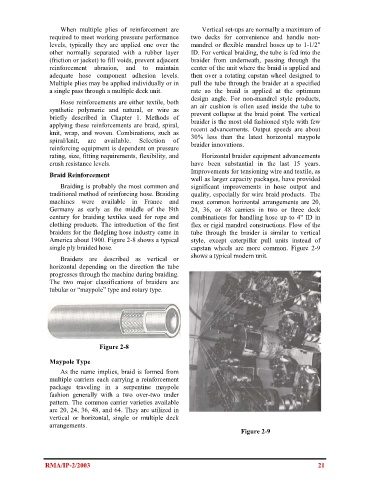
                 America about 1900. Figure 2-8 shows a typical   style,  except  caterpillar  pull units instead of
                 single ply braided hose.                       capstan wheels  are more common.  Figure 2-9
                                                                shows a typical modern unit.
                     Braiders are described  as vertical  or
                 horizontal depending  on  the direction the  tube
                 progresses through the machine during braiding.
                 The two  major  classifications  of braiders are
                 tubular or “maypole” type and rotary type.


                                  Figure 2-8

                 Maypole Type
                     As the name implies, braid is formed from
                 multiple carriers each carrying a reinforcement
                 package  traveling in  a serpentine maypole
                 fashion generally with  a  two  over-two  under
                 pattern. The common carrier varieties available
                 are 20, 24, 36, 48, and 64. They are utilized in
                 vertical or  horizontal, single or multiple  deck
                 arrangements.
                                                                                 Figure 2-9


                RMA/IP-2/2003                                                                             21

