


Page 41 - 2010-2022 hose manufactureing ability and guide
P. 41
Normally, extrusion is the preferred method   Wrapped Tubes
                 for the tubing process on hoses with ID’s up to    For the larger diameter rigid mandrel rubber
                 1-1/2" when built on a flexible mandrel, to 4"   hose constructions, the wrapped tube process is
                 for rigid mandrel.   Beyond these dimensions,   utilized.  Here,  the rubber  compound is
                 wrapped is usually employed. For  the  larger   calendered to  a specific  thickness  and  width,
                 diameter non-mandrel extrusions, the tube may   then spirally wrapped on the rigid mandrel with
                 be  lubricated inside to prevent compound      sufficient  overlap  to form the  tube. With  the
                 tackiness. Also, an air cushion  can  be used   wrapped  process, the challenge is to  provide
                 internally to prevent  tube collapse  during   good bonding at the tube overlap area to prevent
                 extrusion.
                                                                tube delamination.
                     Extruders are often referred to as crosshead
                 or straighthead. If the tube is formed in the same      COVERING OPERATION
                 direction as the extruder’s screw orientation, it   The covering  techniques used for  rubber
                 is a straighthead design, whereas if there is an   and  thermoplastics are  synonymous with  the
                 angle between the tube flow and the screw, it is   tubing techniques described previously. In most
                 a crosshead design. Common crosshead designs   instances the  same equipment is used.
                 are 45° or  90° orientation. Crosshead designs   Frequently a hose  may  have an  extruded  tube
                 offer  more challenges for the process engineer   and a wrapped cover. If extruded, covers must
                 or rubber  chemists since the  abrupt change in   be applied with a crosshead design to allow the
                 rubber  flow direction can induce temperature   reinforced uncured tube to be fed properly into
                 and  pressure anomalies, especially  with      the extruder  covering. The wrapped cover
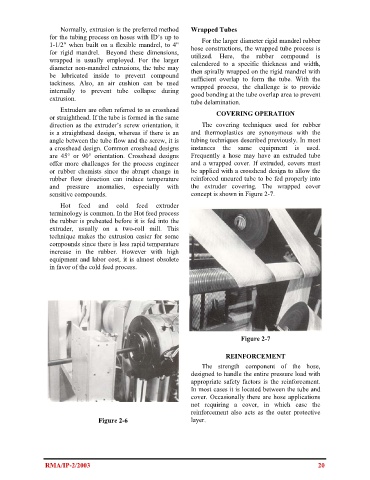
                 sensitive compounds.                           concept is shown in Figure 2-7.

                     Hot feed  and cold feed extruder
                 terminology is common. In the Hot feed process
                 the rubber is preheated before it is fed into the
                 extruder,  usually on a two-roll  mill.  This
                 technique makes  the extrusion easier for some
                 compounds since there is less rapid temperature
                 increase  in the rubber. However  with  high
                 equipment and labor cost, it is almost obsolete
                 in favor of the cold feed process.


                                                                                 Figure 2-7


                                                                            REINFORCEMENT
                                                                    The strength component of the  hose,
                                                                designed to handle the entire pressure load with
                                                                appropriate safety  factors  is the  reinforcement.
                                                                In most cases it is located between the tube and
                                                                cover. Occasionally there are hose applications
                                                                not requiring a cover,  in which  case the
                                                                reinforcement  also  acts as the  outer protective
                                  Figure 2-6                    layer.


                RMA/IP-2/2003                                                                             20

