


Page 191 - Towards Trustworthy Elections New Directions in Electronic Voting by Ed Gerck (auth.), David Chaum, Markus Jakobsson, Ronald L. Rivest, Peter Y. A. Ryan, Josh Benaloh, Miroslaw Kutylowski, Ben Adida ( (z-lib.org (1)
P. 191
On Optical Mark-Sense Scanning
                                                                                            183


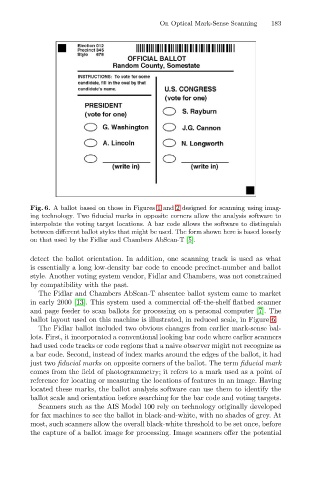
                          Fig. 6. A ballot based on those in Figures 1 and 2 designed for scanning using imag-
                          ing technology. Two fiducial marks in opposite corners allow the analysis software to
                          interpolate the voting target locations. A bar code allows the software to distinguish
                          between different ballot styles that might be used. The form shown here is based loosely
                          on that used by the Fidlar and Chambers AbScan-T [5].

                          detect the ballot orientation. In addition, one scanning track is used as what
                          is essentially a long low-density bar code to encode precinct-number and ballot
                          style. Another voting system vendor, Fidlar and Chambers, was not constrained
                          by compatibility with the past.
                            The Fidlar and Chambers AbScan-T absentee ballot system came to market
                          in early 2000 [13]. This system used a commercial off-the-shelf flatbed scanner
                          and page feeder to scan ballots for processing on a personal computer [7]. The
                          ballot layout used on this machine is illustrated, in reduced scale, in Figure 6.
                            The Fidlar ballot included two obvious changes from earlier mark-sense bal-
                          lots. First, it incorporated a conventional looking bar code where earlier scanners
                          had used code tracks or code regions that a naive observer might not recognize as
                          a bar code. Second, instead of index marks around the edges of the ballot, it had
                          just two fiducial marks on opposite corners of the ballot. The term fiducial mark
                          comes from the field of photogrammetry; it refers to a mark used as a point of
                          reference for locating or measuring the locations of features in an image. Having
                          located these marks, the ballot analysis software can use them to identify the
                          ballot scale and orientation before searching for the bar code and voting targets.
                            Scanners such as the AIS Model 100 rely on technology originally developed
                          for fax machines to see the ballot in black-and-white, with no shades of grey. At
                          most, such scanners allow the overall black-white threshold to be set once, before
                          the capture of a ballot image for processing. Image scanners offer the potential

