


Page 188 - Towards Trustworthy Elections New Directions in Electronic Voting by Ed Gerck (auth.), David Chaum, Markus Jakobsson, Ronald L. Rivest, Peter Y. A. Ryan, Josh Benaloh, Miroslaw Kutylowski, Ben Adida ( (z-lib.org (1)
P. 188
D.W. Jones
                          180
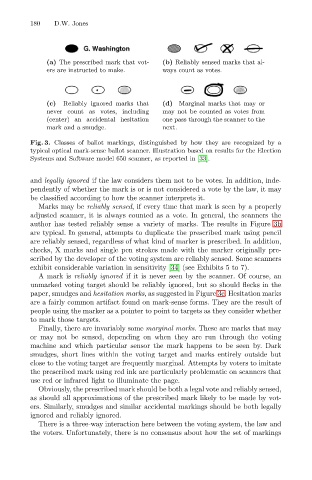
                              (a) The prescribed mark that vot-
                              ers are instructed to make.     (b) Reliably sensed marks that al-
                                                              ways count as votes.
                              (c)  Reliably ignored marks that  (d) Marginal marks that may or
                              never count as votes, including  may not be counted as votes from
                              (center) an accidental hesitation  one pass through the scanner to the
                              mark and a smudge.              next.

                          Fig. 3. Classes of ballot markings, distinguished by how they are recognized by a
                          typical optical mark-sense ballot scanner. Illustration based on results for the Election
                          Systems and Software model 650 scanner, as reported in [33].

                          and legally ignored if the law considers them not to be votes. In addition, inde-
                          pendently of whether the mark is or is not considered a vote by the law, it may
                          be classified according to how the scanner interprets it.
                            Marks may be reliably sensed, if every time that mark is seen by a properly
                          adjusted scanner, it is always counted as a vote. In general, the scanners the
                          author has tested reliably sense a variety of marks. The results in Figure 3b
                          are typical. In general, attempts to duplicate the prescribed mark using pencil
                          are reliably sensed, regardless of what kind of marker is prescribed. In addition,
                          checks, X marks and single pen strokes made with the marker originally pre-
                          scribed by the developer of the voting system are reliably sensed. Some scanners
                          exhibit considerable variation in sensitivity [34] (see Exhibits 5 to 7).
                            Amark is reliably ignored if it is never seen by the scanner. Of course, an
                          unmarked voting target should be reliably ignored, but so should flecks in the
                          paper, smudges and hesitation marks, as suggested in Figure 3c. Hesitation marks
                          are a fairly common artifact found on mark-sense forms. They are the result of
                          people using the marker as a pointer to point to targets as they consider whether
                          to mark those targets.
                            Finally, there are invariably some marginal marks. These are marks that may
                          or may not be sensed, depending on when they are run through the voting
                          machine and which particular sensor the mark happens to be seen by. Dark
                          smudges, short lines within the voting target and marks entirely outside but
                          close to the voting target are frequently marginal. Attempts by voters to imitate
                          the prescribed mark using red ink are particularly problematic on scanners that
                          use red or infrared light to illuminate the page.
                            Obviously, the prescribed mark should be both a legal vote and reliably sensed,
                          as should all approximations of the prescribed mark likely to be made by vot-
                          ers. Similarly, smudges and similar accidental markings should be both legally
                          ignored and reliably ignored.
                            There is a three-way interaction here between the voting system, the law and
                          the voters. Unfortunately, there is no consensus about how the set of markings

