


Page 189 - Towards Trustworthy Elections New Directions in Electronic Voting by Ed Gerck (auth.), David Chaum, Markus Jakobsson, Ronald L. Rivest, Peter Y. A. Ryan, Josh Benaloh, Miroslaw Kutylowski, Ben Adida ( (z-lib.org (1)
P. 189
181
                                                              On Optical Mark-Sense Scanning
                          on a ballot should be legally classified. The most dangerous approach is known
                          as the machine model. This defines as legal votes whatever the machine accepts
                          [14]. The machine model does not allow for the existence of marginal marks, nor
                          does it provide any criteria for judging whether the scanners conform to the law.
                            At the other extreme are laws that enumerate the types of markings that are
                          legal votes. Consider, for example, Michigan’s rules as of 2004 [9]. These rules,
                          and the law on which they are based, do not distinguish between the sensitive
                          area and the voting target. They declare some markings to be legal votes that a
                          scanner may miss, while declaring other marks to be legally ignored even though
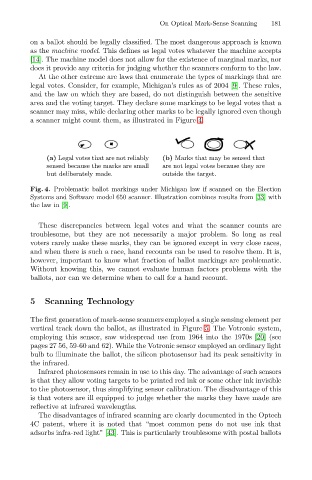
                          a scanner might count them, as illustrated in Figure 4.


                              (a) Legal votes that are not reliably  (b) Marks that may be sensed that
                              sensed because the marks are small  are not legal votes because they are
                              but deliberately made.          outside the target.

                          Fig. 4. Problematic ballot markings under Michigan law if scanned on the Election
                          Systems and Software model 650 scanner. Illustration combines results from [33] with
                          the law in [9].

                            These discrepancies between legal votes and what the scanner counts are
                          troublesome, but they are not necessarily a major problem. So long as real
                          voters rarely make these marks, they can be ignored except in very close races,
                          and when there is such a race, hand recounts can be used to resolve them. It is,
                          however, important to know what fraction of ballot markings are problematic.
                          Without knowing this, we cannot evaluate human factors problems with the
                          ballots, nor can we determine when to call for a hand recount.


                          5   Scanning Technology

                          The first generation of mark-sense scanners employed a single sensing element per
                          vertical track down the ballot, as illustrated in Figure 5. The Votronic system,
                          employing this sensor, saw widespread use from 1964 into the 1970s [20] (see
                          pages 27 56, 59-60 and 62). While the Votronic sensor employed an ordinary light
                          bulb to illuminate the ballot, the silicon photosensor had its peak sensitivity in
                          the infrared.
                            Infrared photosensors remain in use to this day. The advantage of such sensors
                          is that they allow voting targets to be printed red ink or some other ink invisible
                          to the photosensor, thus simplifying sensor calibration. The disadvantage of this
                          is that voters are ill equipped to judge whether the marks they have made are
                          reflective at infrared wavelengths.
                            The disadvantages of infrared scanning are clearly documented in the Optech
                          4C patent, where it is noted that “most common pens do not use ink that
                          adsorbs infra-red light” [43]. This is particularly troublesome with postal ballots

