


Page 285 - Towards Trustworthy Elections New Directions in Electronic Voting by Ed Gerck (auth.), David Chaum, Markus Jakobsson, Ronald L. Rivest, Peter Y. A. Ryan, Josh Benaloh, Miroslaw Kutylowski, Ben Adida ( (z-lib.org (1)
P. 285
A Verifiable Voting Protocol Based on Farnel
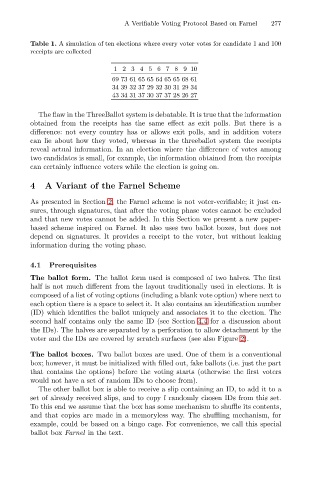
                          Table 1. A simulation of ten elections where every voter votes for candidate 1 and 100
                          receipts are collected
                                                 123456789 10                               277
                                                69 73 61 65 65 64 65 65 68 61
                                                34 39 32 37 29 32 30 31 29 34
                                                43 34 31 37 30 37 37 28 26 27
                            The flaw in the ThreeBallot system is debatable. It is true that the information
                          obtained from the receipts has the same effect as exit polls. But there is a
                          difference: not every country has or allows exit polls, and in addition voters
                          can lie about how they voted, whereas in the threeballot system the receipts
                          reveal actual information. In an election where the difference of votes among
                          two candidates is small, for example, the information obtained from the receipts
                          can certainly influence voters while the election is going on.

                          4   A Variant of the Farnel Scheme

                          As presented in Section 2, the Farnel scheme is not voter-verifiable; it just en-
                          sures, through signatures, that after the voting phase votes cannot be excluded
                          and that new votes cannot be added. In this Section we present a new paper-
                          based scheme inspired on Farnel. It also uses two ballot boxes, but does not
                          depend on signatures. It provides a receipt to the voter, but without leaking
                          information during the voting phase.


                          4.1  Prerequisites
                          The ballot form. The ballot form used is composed of two halves. The first
                          half is not much different from the layout traditionally used in elections. It is
                          composed of a list of voting options (including a blank vote option) where next to
                          each option there is a space to select it. It also contains an identification number
                          (ID) which identifies the ballot uniquely and associates it to the election. The
                          second half contains only the same ID (see Section 4.4 for a discussion about
                          the IDs). The halves are separated by a perforation to allow detachment by the
                          voter and the IDs are covered by scratch surfaces (see also Figure 2).

                          The ballot boxes. Two ballot boxes are used. One of them is a conventional
                          box; however, it must be initialized with filled out, fake ballots (i.e. just the part
                          that contains the options) before the voting starts (otherwise the first voters
                          would not have a set of random IDs to choose from).
                            The other ballot box is able to receive a slip containing an ID, to add it to a
                          set of already received slips, and to copy l randomly chosen IDs from this set.
                          To this end we assume that the box has some mechanism to shuffle its contents,
                          and that copies are made in a memoryless way. The shuffling mechanism, for
                          example, could be based on a bingo cage. For convenience, we call this special
                          ballot box Farnel in the text.

