


Page 287 - Towards Trustworthy Elections New Directions in Electronic Voting by Ed Gerck (auth.), David Chaum, Markus Jakobsson, Ronald L. Rivest, Peter Y. A. Ryan, Josh Benaloh, Miroslaw Kutylowski, Ben Adida ( (z-lib.org (1)
P. 287
A Verifiable Voting Protocol Based on Farnel


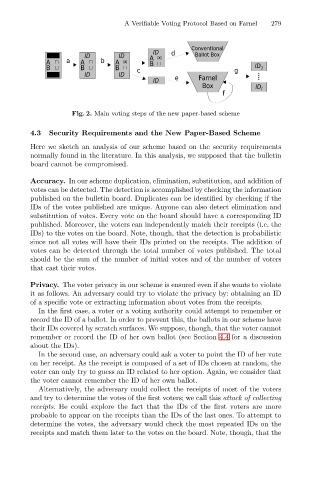
                                     Fig. 2. Main voting steps of the new paper-based scheme  279

                          4.3  Security Requirements and the New Paper-Based Scheme

                          Here we sketch an analysis of our scheme based on the security requirements
                          normally found in the literature. In this analysis, we supposed that the bulletin
                          board cannot be compromised.

                          Accuracy. In our scheme duplication, elimination, substitution, and addition of
                          votes can be detected. The detection is accomplished by checking the information
                          published on the bulletin board. Duplicates can be identified by checking if the
                          IDs of the votes published are unique. Anyone can also detect elimination and
                          substitution of votes. Every vote on the board should have a corresponding ID
                          published. Moreover, the voters can independently match their receipts (i.e. the
                          IDs) to the votes on the board. Note, though, that the detection is probabilistic
                          since not all votes will have their IDs printed on the receipts. The addition of
                          votes can be detected through the total number of votes published. The total
                          should be the sum of the number of initial votes and of the number of voters
                          that cast their votes.

                          Privacy. The voter privacy in our scheme is ensured even if she wants to violate
                          it as follows. An adversary could try to violate the privacy by: obtaining an ID
                          of a specific vote or extracting information about votes from the receipts.
                            In the first case, a voter or a voting authority could attempt to remember or
                          record the ID of a ballot. In order to prevent this, the ballots in our scheme have
                          their IDs covered by scratch surfaces. We suppose, though, that the voter cannot
                          remember or record the ID of her own ballot (see Section 4.4 for a discussion
                          about the IDs).
                            In the second case, an adversary could ask a voter to point the ID of her vote
                          on her receipt. As the receipt is composed of a set of IDs chosen at random, the
                          voter can only try to guess an ID related to her option. Again, we consider that
                          the voter cannot remember the ID of her own ballot.
                            Alternatively, the adversary could collect the receipts of most of the voters

                          and try to determine the votes of the first voters; we call this attack of collecting
                          receipts. He could explore the fact that the IDs of the first voters are more
                          probable to appear on the receipts than the IDs of the last ones. To attempt to
                          determine the votes, the adversary would check the most repeated IDs on the
                          receipts and match them later to the votes on the board. Note, though, that the

