


Page 40 - Towards_a_New_Malaysia_The_2018_Election_and_Its_6146371_(z-lib.org)
P. 40
How Malaysia Voted in 2018                                    25

                  was also very high in 2018, reaching 81 per cent, only marginally lower than
                  the 81.5 per cent recorded in 2013.

                  Table 2.5   Voter turnout by age group in 2018 and 2013

                   Mean age   2018 turnout (%)  2013 turnout (%)    Variance (%)
                   21–29           80.1              84.0              –3.9
                   30–39           80.3              84.3              –4.0
                   40–49           83.8              86.5              –2.7
                   50–59           85.9              87.0              –1.1
                   60–69           84.4              85.7              –1.3
                   70++            74.7              75.8              –1.1

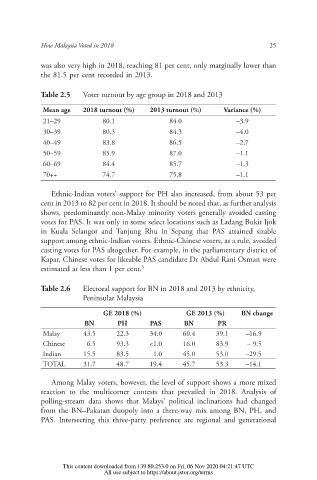
                     Ethnic-Indian voters’ support for PH also increased, from about 53 per
                  cent in 2013 to 82 per cent in 2018. It should be noted that, as further analysis
                  shows, predominantly non-Malay minority voters generally avoided casting
                  votes for PAS. It was only in some select locations such as Ladang Bukit Ijok
                  in  Kuala  Selangor  and  Tanjung  Rhu  in  Sepang  that  PAS  attained  sizable
                  support among ethnic-Indian voters. Ethnic-Chinese voters, as a rule, avoided
                  casting votes for PAS altogether. For example, in the parliamentary district of
                  Kapar, Chinese votes for likeable PAS candidate Dr Abdul Rani Osman were
                  estimated at less than 1 per cent. 5


                  Table 2.6   Electoral support for BN in 2018 and 2013 by ethnicity,
                              Peninsular Malaysia

                                   GE 2018 (%)           GE 2013 (%)    BN change
                              BN       PH       PAS      BN       PR
                   Malay      43.5     22.3     34.0     60.4     39.1    –16.9
                   Chinese     6.5     93.3     <1.0     16.0     83.9    – 9.5
                   Indian     15.5     83.5      1.0     45.0     53.0   –29.5
                   TOTAL      31.7     48.7     19.4     45.7    53.3    –14.1

                     Among Malay voters, however, the level of support shows a more mixed
                  reaction to the multicorner contests that prevailed in 2018. Analysis of
                  polling-stream  data  shows  that  Malays’  political  inclinations  had  changed
                  from the BN–Pakatan duopoly into a three-way mix among BN, PH, and
                  PAS. Intersecting this three-party preference are regional and generational


                        This content downloaded from 139.80.253.0 on Fri, 06 Nov 2020 04:21:47 UTC
                                   All use subject to https://about.jstor.org/terms

