


Page 51 - Towards_a_New_Malaysia_The_2018_Election_and_Its_6146371_(z-lib.org)
P. 51
36                                        Ibrahim Su an and Lee Tai De

                  group, most districts in Sabah are composed of many subethnic groups, none
                  of which forms a majority.

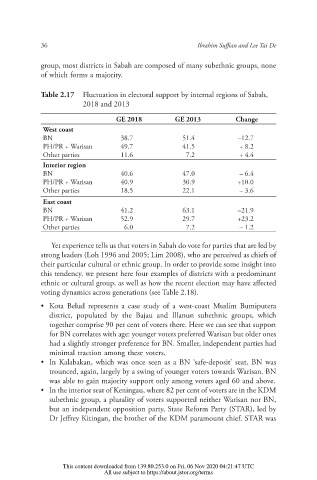
                  Table 2.17  Fluctuation in electoral support by internal regions of Sabah,
                              2018 and 2013
                                       GE 2018        GE 2013          Change
                   West coast
                   BN                   38.7            51.4           –12.7
                   PH/PR + Warisan      49.7            41.5            + 8.2
                   Other parties        11.6              7.2           + 4.4
                   Interior region
                   BN                   40.6            47.0            – 6.4
                   PH/PR + Warisan      40.9            30.9           +10.0
                   Other parties        18.5            22.1            – 3.6
                   East coast
                   BN                   41.2            63.1           –21.9
                   PH/PR + Warisan      52.9            29.7           +23.2
                   Other parties         6.0             7.2            – 1.2

                     Yet experience tells us that voters in Sabah do vote for parties that are led by
                  strong leaders (Loh 1996 and 2005; Lim 2008), who are perceived as chiefs of
                  their particular cultural or ethnic group. In order to provide some insight into
                  this tendency, we present here four examples of districts with a predominant
                  ethnic or cultural group, as well as how the recent election may have a ected
                  voting dynamics across generations (see Table 2.18).

                  •  Kota Belud represents a case study of a west-coast Muslim Bumiputera
                     district, populated by the Bajau and Illanun subethnic groups, which
                     together comprise 90 per cent of voters there. Here we can see that support
                     for BN correlates with age: younger voters preferred Warisan but older ones
                     had a slightly stronger preference for BN. Smaller, independent parties had
                     minimal traction among these voters.
                  •  In Kalabakan, which was once seen as a BN ‘safe-deposit’ seat, BN was
                     trounced, again, largely by a swing of younger voters towards Warisan. BN
                     was able to gain majority support only among voters aged 60 and above.
                  •  In the interior seat of Keningau, where 82 per cent of voters are in the KDM
                     subethnic group, a plurality of voters supported neither Warisan nor BN,
                     but an independent opposition party, State Reform Party (STAR), led by
                     Dr Je rey Kitingan, the brother of the KDM paramount chief. STAR was


                        This content downloaded from 139.80.253.0 on Fri, 06 Nov 2020 04:21:47 UTC
                                   All use subject to https://about.jstor.org/terms

