


Page 46 - Towards_a_New_Malaysia_The_2018_Election_and_Its_6146371_(z-lib.org)
P. 46
How Malaysia Voted in 2018                                    31

                  marked improvement compared to GE13; the BN’s popular vote increased
                  from 58.9 per cent in 2013 to 62.3 per cent in 2016.

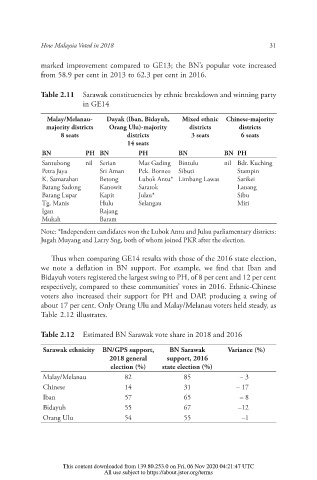
                  Table 2.11  Sarawak constituencies by ethnic breakdown and winning party
                              in GE14
                    Malay/Melanau-  Dayak (Iban, Bidayuh,   Mixed ethnic  Chinese-majority
                    majority districts  Orang Ulu)-majority   districts  districts
                        8 seats          districts         3 seats      6 seats
                                          14 seats
                   BN         PH BN          PH        BN           BN PH
                   Santubong  nil  Serian    Mas Gading  Bintulu    nil Bdr. Kuching
                   Petra Jaya     Sri Aman   Pck. Borneo  Sibuti       Stampin
                   K. Samarahan   Betong     Lubok Antu* Limbang Lawas  Sarikei
                   Batang Sadong  Kanowit    Saratok                   Lanang
                   Batang Lupar   Kapit      Julau*                    Sibu
                   Tg. Manis      Hulu       Selangau                  Miri
                   Igan           Rajang
                   Mukah          Baram
                  Note: *Independent candidates won the Lubok Antu and Julau parliamentary districts:
                  Jugah Muyang and Larry Sng, both of whom joined PKR after the election.


                      us when comparing GE14 results with those of the 2016 state election,
                  we note a de ation in BN support. For example, we  nd that Iban and
                  Bidayuh voters registered the largest swing to PH, of 8 per cent and 12 per cent
                  respectively, compared to these communities’ votes in 2016. Ethnic-Chinese
                  voters also increased their support for PH and DAP, producing a swing of
                  about 17 per cent. Only Orang Ulu and Malay/Melanau voters held steady, as
                  Table 2.12 illustrates.

                  Table 2.12  Estimated BN Sarawak vote share in 2018 and 2016

                   Sarawak ethnicity  BN/GPS support,   BN Sarawak   Variance (%)
                                     2018 general   support, 2016
                                     election (%)  state election (%)
                   Malay/Melanau         82              85             – 3
                   Chinese               14              31            – 17
                   Iban                  57              65             – 8
                   Bidayuh               55              67            –12
                   Orang Ulu             54              55              –1


                        This content downloaded from 139.80.253.0 on Fri, 06 Nov 2020 04:21:47 UTC
                                   All use subject to https://about.jstor.org/terms

