


Page 48 - Towards_a_New_Malaysia_The_2018_Election_and_Its_6146371_(z-lib.org)
P. 48
How Malaysia Voted in 2018                                    33

                     Table 2.13 suggests that younger voters tended to favour PH more than
                  BN, with the exception of Iban voters in Selangau, where we see no di erence
                  between younger and older voters. Even among the Sarawak Malay voters in
                  the state-administrative seat of Petrajaya, younger voters, while favouring BN,
                  did so at signi cantly lower rates than older voters.  is pattern may have
                  implications for BN Sarawak/GPS in the future.
                     Sarawak holds its state elections separately from parliamentary elections. It
                  will be at least another two years (at the time of writing) before the state goes
                  to the polls again to elect state representatives.  e results of GE14 for BN
                  Sarawak are similar to the fate of BN in Peninsular Malaysia.  e GPS/BN
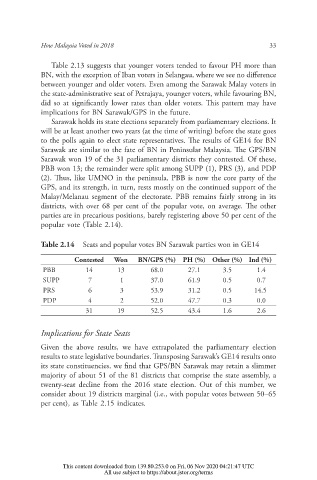
                  Sarawak won 19 of the 31 parliamentary districts they contested. Of these,
                  PBB won 13; the remainder were split among SUPP (1), PRS (3), and PDP
                  (2).  us, like UMNO in the peninsula, PBB is now the core party of the
                  GPS, and its strength, in turn, rests mostly on the continued support of the
                  Malay/Melanau segment of the electorate. PBB remains fairly strong in its
                  districts, with over 68 per cent of the popular vote, on average.  e other
                  parties are in precarious positions, barely registering above 50 per cent of the
                  popular vote (Table 2.14).

                  Table 2.14  Seats and popular votes BN Sarawak parties won in GE14

                           Contested  Won   BN/GPS (%) PH (%) Other (%) Ind (%)
                   PBB        14       13       68.0      27.1     3.5       1.4
                   SUPP         7       1       37.0      61.9     0.5       0.7
                   PRS          6       3       53.9      31.2     0.5      14.5
                   PDP          4       2       52.0      47.7     0.3       0.0
                              31       19       52.5      43.4     1.6       2.6


                  Implications for State Seats
                  Given the above results, we have extrapolated the parliamentary election
                  results to state legislative boundaries. Transposing Sarawak’s GE14 results onto
                  its state constituencies, we  nd that GPS/BN Sarawak may retain a slimmer
                  majority of about 51 of the 81 districts that comprise the state assembly, a
                  twenty-seat decline from the 2016 state election. Out of this number, we
                  consider about 19 districts marginal (i.e., with popular votes between 50–65
                  per cent), as Table 2.15 indicates.


                        This content downloaded from 139.80.253.0 on Fri, 06 Nov 2020 04:21:47 UTC
                                   All use subject to https://about.jstor.org/terms

