


Page 79 - Towards_a_New_Malaysia_The_2018_Election_and_Its_6146371_(z-lib.org)
P. 79
64                                               Helen Ting Mu Hung

                  it as recently as the 1990s. In February 1991, Prime Minister Dr Mahathir
                  announced a new policy called  Vision 2020. Among other provisions, it
                  entailed liberalizing previously restrictive cultural policies and increasing local
                  private higher-education opportunities, changes that non-Malays welcomed
                  (Loh 2002).  is toning-down of the BN government’s pro-Malay ethnic
                  policies might have been partly motivated by the growing strength of the Malay
                  opposition in the 1990 general elections, as well as the ability of Semangat ’46
                  to form two coalitions to unite opposition parties.  ough BN was returned
                  with a two-thirds majority in 1990, its popular vote dipped to its lowest point
                                                           6
                  since 1969, at 51.95 per cent (Khong 1991: 15).  UMNO did not win any
                  parliamentary seats in Kelantan, and also lost control of the Kelantan state
                  government to APU, while MCA won only 18 out of the 32 parliamentary
                  seats it contested, 13 of which were in constituencies where Chinese voters
                  formed less than 50 per cent of the electorate (Khong 1991: 27).
                     Propagating a more inclusive narrative of the Malaysian nation,  bangsa
                  Malaysia, as multiethnic and multireligious (Lee 2004) paid o  for BN
                  during the 1995 general elections, drawing a surge in Chinese support,
                  leading correspondingly to a signi cant drop in support for DAP candidates
                  (Gomez 1996).  e BN’s gain, however, was largely limited to Chinese voters:
                  UMNO did not improve its performance signi cantly in the heavily Malay
                  northeastern states of Kedah, Kelantan, and Terengganu when compared with
                  1990, due both to continued factionalism within the party and to PAS’s strong
                  showing in its traditional stronghold.

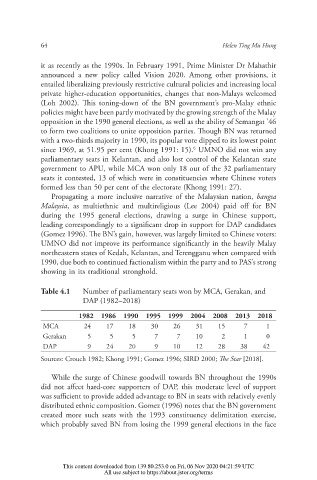
                  Table 4.1   Number of parliamentary seats won by MCA, Gerakan, and
                              DAP (1982–2018)
                            1982   1986  1990  1995  1999  2004  2008  2013  2018
                   MCA        24    17    18    30    26    31    15      7     1
                   Gerakan     5     5     5     7     7    10      2     1     0
                   DAP         9    24    20     9    10    12    28    38    42
                  Sources: Crouch 1982; Khong 1991; Gomez 1996; SIRD 2000;  e Star [2018].


                     While the surge of Chinese goodwill towards BN throughout the 1990s
                  did not a ect hard-core supporters of DAP, this moderate level of support
                  was su cient to provide added advantage to BN in seats with relatively evenly
                  distributed ethnic composition. Gomez (1996) notes that the BN government
                  created more such seats with the 1993 constituency delimitation exercise,
                  which probably saved BN from losing the 1999 general elections in the face


                        This content downloaded from 139.80.253.0 on Fri, 06 Nov 2020 04:21:59 UTC
                                   All use subject to https://about.jstor.org/terms

