


Page 80 - Towards_a_New_Malaysia_The_2018_Election_and_Its_6146371_(z-lib.org)
P. 80
Cross-ethnic Vote-pooling in West Malaysia                    65

                  of the rising tide of Malay discontent following the onset of the Reformasi
                  movement. Analysis of the 1999 election outcome indicates that both Malay
                  and non-Malay votes were more or less evenly split between BN and BA,
                  depending on constituency characteristics (SIRD 2000). PAS captured the
                  state government of Terengganu while maintaining its grip on the state of
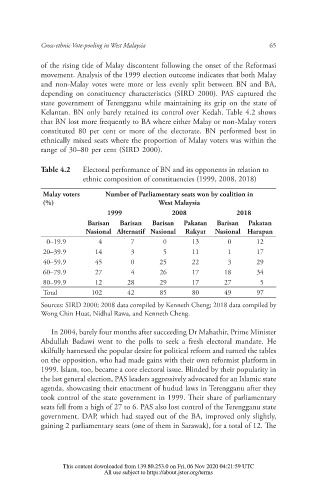
                  Kelantan. BN only barely retained its control over Kedah. Table 4.2 shows
                  that BN lost more frequently to BA where either Malay or non-Malay voters
                  constituted 80 per cent or more of the electorate. BN performed best in
                  ethnically mixed seats where the proportion of Malay voters was within the
                  range of 30–80 per cent (SIRD 2000).


                  Table 4.2   Electoral performance of BN and its opponents in relation to
                              ethnic composition of constituencies (1999, 2008, 2018)

                   Malay voters     Number of Parliamentary seats won by coalition in
                   (%)                            West Malaysia
                                    1999              2008             2018
                               Barisan   Barisan   Barisan   Pakatan   Barisan   Pakatan
                              Nasional Alternatif Nasional  Rakyat  Nasional Harapan
                    0–19.9        4        7        0      13        0      12
                   20–39.9       14        3        5      11        1      17
                   40–59.9       45        0      25       22        3      29
                   60–79.9       27        4      26       17       18      34
                   80–99.9       12       28      29       17       27        5
                   Total        102       42      85       80       49      97
                  Sources: SIRD 2000; 2008 data compiled by Kenneth Cheng; 2018 data compiled by
                  Wong Chin Huat, Nidhal Rawa, and Kenneth Cheng.

                     In 2004, barely four months after succeeding Dr Mahathir, Prime Minister
                  Abdullah Badawi  went  to  the polls  to seek a  fresh  electoral  mandate. He
                  skilfully harnessed the popular desire for political reform and turned the tables
                  on the opposition, who had made gains with their own reformist platform in
                  1999. Islam, too, became a core electoral issue. Blinded by their popularity in
                  the last general election, PAS leaders aggressively advocated for an Islamic state
                  agenda, showcasing their enactment of hudud laws in Terengganu after they
                  took control of the state government in 1999.  eir share of parliamentary
                  seats fell from a high of 27 to 6. PAS also lost control of the Terengganu state
                  government. DAP, which had stayed out of the BA, improved only slightly,
                  gaining 2 parliamentary seats (one of them in Sarawak), for a total of 12.  e


                        This content downloaded from 139.80.253.0 on Fri, 06 Nov 2020 04:21:59 UTC
                                   All use subject to https://about.jstor.org/terms

