


Page 82 - Towards_a_New_Malaysia_The_2018_Election_and_Its_6146371_(z-lib.org)
P. 82
Cross-ethnic Vote-pooling in West Malaysia                    67

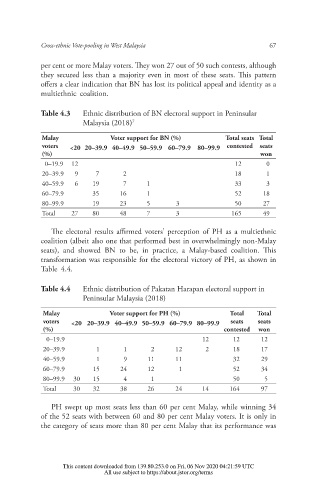
                  per cent or more Malay voters.  ey won 27 out of 50 such contests, although
                  they secured less than a majority even in most of these seats.  is pattern
                  o ers a clear indication that BN has lost its political appeal and identity as a
                  multiethnic coalition.

                  Table 4.3   Ethnic distribution of BN electoral support in Peninsular
                              Malaysia (2018) 7
                   Malay             Voter support for BN (%)       Total seats  Total
                   voters   <20 20–39.9 40–49.9 50–59.9 60–79.9  80–99.9  contested  seats
                   (%)                                                       won
                   0–19.9  12                                          12       0
                   20–39.9   9    7      2                             18       1
                   40–59.9   6  19       7     1                       33       3
                   60–79.9      35      16     1                       52     18
                   80–99.9      19      23     5       3               50     27
                   Total  27    80      48     7       3              165     49

                      e electoral results a rmed voters’ perception of PH as a multiethnic
                  coalition (albeit also one that performed best in overwhelmingly non-Malay
                  seats),  and  showed  BN  to  be,  in  practice,  a  Malay-based  coalition.   is
                  transformation was responsible for the electoral victory of PH, as shown in
                  Table 4.4.


                  Table 4.4   Ethnic distribution of Pakatan Harapan electoral support in
                              Peninsular Malaysia (2018)

                   Malay             Voter support for PH (%)        Total   Total
                   voters   <20 20–39.9 40–49.9 50–59.9 60–79.9 80–99.9  seats   seats
                   (%)                                              contested  won
                    0–19.9                                    12       12     12
                   20–39.9       1       1      2      12      2       18     17
                   40–59.9       1       9     11      11              32     29
                   60–79.9      15      24     12       1              52     34
                   80–99.9  30  15       4      1                      50      5
                   Total   30   32      38     26      24     14     164      97
                     PH swept up most seats less than 60 per cent Malay, while winning 34
                  of the 52 seats with between 60 and 80 per cent Malay voters. It is only in
                  the category of seats more than 80 per cent Malay that its performance was


                        This content downloaded from 139.80.253.0 on Fri, 06 Nov 2020 04:21:59 UTC
                                   All use subject to https://about.jstor.org/terms

