


Page 140 - sarah-simblet_sketch-book-for-the-artist
P. 140
PORTRAITURE140                                                      or eggshells with animal glue, laid on paper,          STRETCHING PAPER
                                                                    parchment, or wood. The most common
             Silver Point                                           metal has always been silver—hence the term            A sheet o f paper that has
                                                                    "silver point." Lead, copper, platinum, and            been made wet with the
                     SILVER OR METAL POINT was familiar to          gold have also been used, and alloys work              strokes of a paintbrush will
                     illuminators of medieval manuscripts,          on matt emulsion. Note how domestic                    buckle due t o its uneven
                     who used it to outline initials and border     paintwork marks with a coin, key, or ring;             expansion. Stretched paper
                     characters before painting. Numerous early     an exciting indication of how large-scale              remains taut as a d r u m , and
                     European artists also enjoyed its fine         drawings could be made on a wall.                      is therefore useful w h e n using
                     qualities (see p. 156). Metal point is simply                                                         w a t e r c o l o r as well as silver
                     a strip of metal bound in a holder. Drawn         Opposite, I combined silver point with              point. Lay a clean drawing
                     across a prepared surface, it leaves a         painted white gouache on a pink ground.                board on a flat surface. Take a
                     deposit, which quickly oxidizes into a gray    This is called a three-tone drawing. Pages             sheet of any type o f paper (for
                     line. This browns with age unless sealed by                                                           example, white drawing paper)
                     fixative (see pp.54-55). Metal point does not                                                         and cut it to fit your drawing
                     work on ordinary paper; the surface must                                                              board with a generous border
                                                                                                                           around its edges.Tear off four
                                                                                                                           lengths of brown paper gum
                                                                                                                           tape, one to fit each side o f
                                                                                                                           the board—these will make
                                                                                                                           the glued frame that holds
                                                                                                                           your paper in place.

             be primed with a ground such as gouache. 142 to 147 are illustrated in silver point and

             Historically, artists mixed white lead, bone, techniques are explained on pp. 144-45.

             MATERIALS

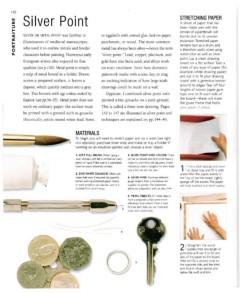
             To begin, you will need t o stretch paper and lay a wash (see right
             and opposite), purchase silver wire, and make o r buy a holder. If
             working on an emulsion-painted wall, choose a silver object.

             1. S O F T FULL BRUSH: W h e n laying a                      3. SILVER P O I N T W I R E H O L D E R : These  1Find a clean sponge and b o w l
             wash, choose a soft full brush that can carry                can b e purchased and t e n d t o b eheavy. I             o r deep tray and fill it w i t h
             plenty o f liquid. M a k e sure it is c o m p l e t e l y    make my o w n from old dip pens. Empty            water W e t the paper evenly in
             clean t o avoid unwanted streaks.                            mechanical pencils designed for thick leads       the tray o r on the board. Lightly
                                                                          ( s e e p.54) c a n a l s o b e u s e d .         sponge off the excess. The paper
             2. Z I N C W H I T E G O U A C H E : Dilute with                                                               will look buckled, but don't worry.
             w a t e r A d d c o l o r i f r e q u i r e d (as opposite)  4. SILVER WIRE: Purchase different
             before priming stretched paper. Gesso                        gauge lengths from a traditional a r t
             o r m a t t e m u l s i o n c a n also b e u s e d . I t is  supplier o rjeweler. For important
             available f r o m all a r t shops.                           advice on preparation and use, see p.144.

                                                                          5. METAL OBJECTS: All metal objects
                                                                          mark a prepared surface, some more
                                                                          effectively t h a n others. Silver is best.
                                                                          Find an item that you can hold and
                                                                          draw with comfortably.

                                                                                                                           2 Straighten the worst
                                                                                                                                   buckles. W e t one length o f
                                                                                                                           gum-strip and use it t o fix one
                                                                                                                           side of the paper to the board.
                                                                                                                           W e t and fix a second strip t o
                                                                                                                           the opposite side, and the third
                                                                                                                           and fourth strips above and
                                                                                                                           below. Be swift and firm.

